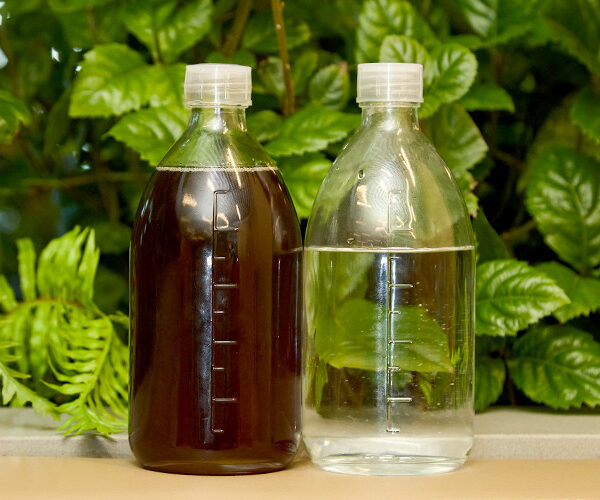
On August 30, 2024, an international passenger flight departing from Incheon International Airport was fueled with Sustainable Aviation Fuel (SAF) for the first time, marking a new milestone in Korea’s aviation sector.
This low-carbon fuel, produced from bio-based feedstocks such as used cooking oil and animal fats, is globally recognized as a key solution for achieving carbon neutrality in the aviation sector. Starting in 2027, all international flights worldwide will be required to use blended SAF.
The innovators at SK Energy, who pioneered Korea’s SAF journey, now envision a future when Made-in-Korea SAF becomes the new standard soaring through the skies.
Q1. Today, we are joined by three Innovators who have set a new milestone in Korea’s aviation industry. To begin, may I ask each of you to briefly introduce yourselves?
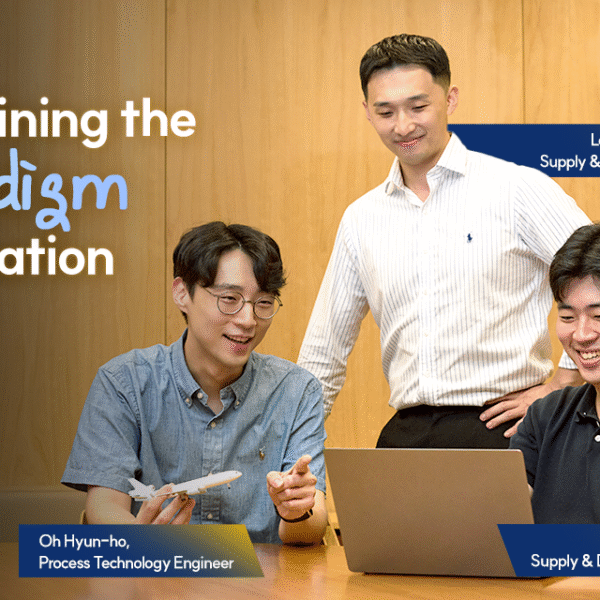
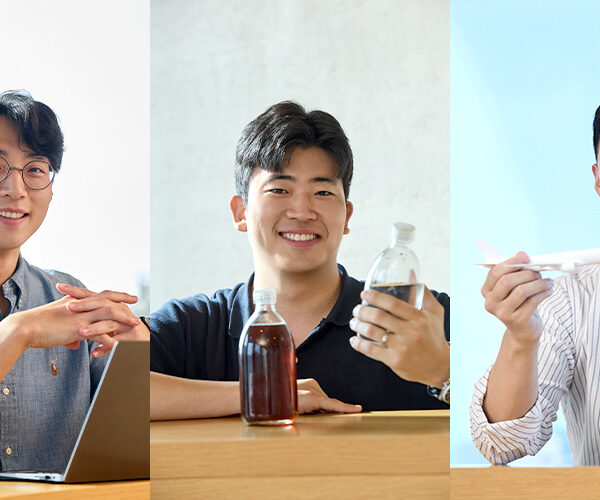
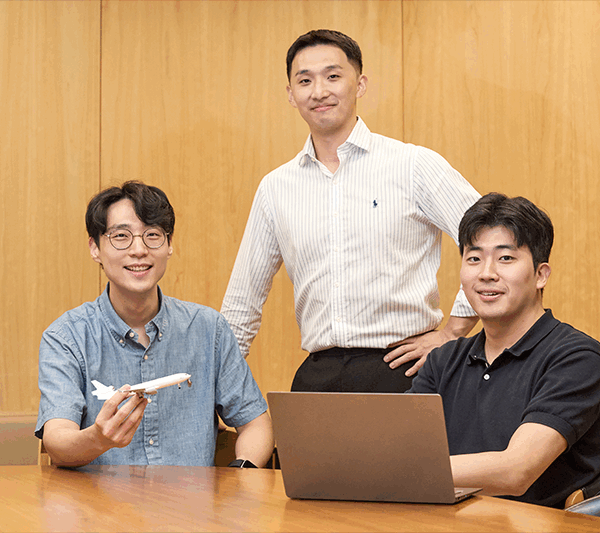
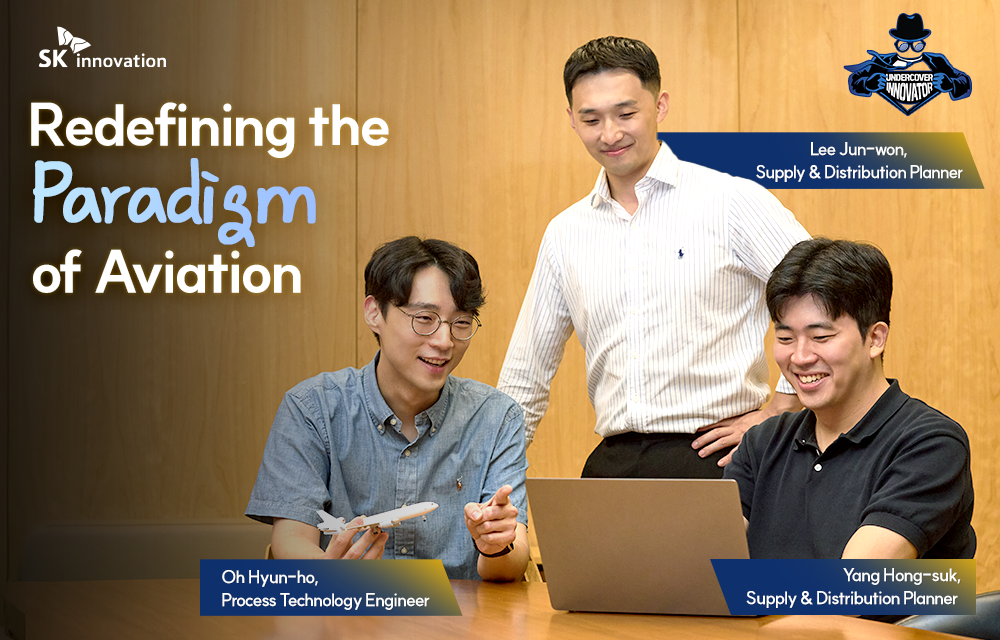
Oh Hyun-ho, Process Technology Engineer of Petroleum Production Technology Team (Oh): Hello. I’m Oh Hyun-ho, and I’m with the Petroleum Production Technology 1 Team at SK Energy.
Yang Hong-suk, Supply & Distribution Planner of Supply Chain Operations Team (Yang): Thank you, glad to be here. I’m Yang Hong-suk from the Supply Chain Operations Team at SK Energy.
Lee Jun-won, Supply & Distribution Planner of Supply Chain Optimization Team (Lee): It is a pleasure to meet you. I’m Lee Jun-won from the Supply Chain Optimization Team at SK Energy.

Q2. It’s been a year since SK Energy built Korea’s first dedicated SAF production line and began commercial production. Looking back, what moments stand out to you the most?
Lee: The day that stands out most vividly was in late 2024, when our very first vessel carrying SAF destined for Europe set sail. My colleagues and I gathered in front of the ship to take a commemorative photo. It had taken us nearly four years from the time we began considering the biofuel business back in 2020 to finally exporting our first product. I still remember how proud I felt, knowing we had marked a significant milestone in the company’s history.
Yang: For me, it was the moment we heard our project had passed the company’s Investment Review Committee. We were all thrilled, and being part of the very first step in SK Energy’s SAF journey felt profoundly meaningful.
Oh: For me, the most memorable moment was when we first introduced bio-based feedstock and confirmed that the SAF we produced successfully met the required on-spec quality standards. As this was Korea’s first commercial production of SAF, we had to rigorously verify each potential process risk associated with using bio feedstock, which wasn’t easy. Through close collaboration between key departments—SK Innovation Ulsan Complex (Ulsan CLX), the Institute of Environmental Science & Technology in Daejeon, and our Seoul headquarters—we were able to resolve numerous technical concerns related to the Co-processing⁽¹⁾. And by leveraging SK Innovation’s own technological capabilities, we not only validated the process but also succeeded in establishing a new value chain. That accomplishment remains a source of great pride for me.
(1) Co-processing: Simultaneously processing petroleum and bio-based feedstocks to produce both conventional and low-carbon fuels.
Q3. Upon building the production line, SK Energy marked another milestone by successfully exporting SAF to Europe, the first achievement of its kind in Korea. Could you tell us more about the process and what it meant to you?
Lee: From 2025, the European Union (EU) began enforcing a mandate that requires all flights departing from EU airports to use SAF blends⁽²⁾. Since SAF is two to three times more expensive than conventional jet fuel, policy support is crucial to drive market demand. In that sense, Europe quickly became the most advanced and well-structured SAF market compared to other regions. By making an early entry into Europe, we were able to closely observe market dynamics, from feedstock to finished SAF products. I believe this served as an important early learning experience, equipping us with the knowledge and insight needed to establish a competitive edge once the Asian SAF market begins to take shape.
(2) Under the ReFuelEU Aviation regulation, the European Union requires all aircraft departing from EU airports to use blended SAF starting in 2025.
In China and Singapore, large-scale SAF production plants are already in operation. But in major aviation hubs such as Incheon and Tokyo, there are only a handful of companies, including us, that are engaged in commercial SAF production. That’s why being able to quickly capture the growing demand in nearby regions and establish a robust supply chain is especially meaningful.
Yang: I think it’s highly significant that that SK Energy, through its own independent technical evaluations and market analyses, became the first in Korea to successfully produce and export SAF to Europe, the global leader in SAF adoption. Building on this expertise, we are now entering the fast-growing regional SAF market as well. This accomplishment is also a strong reflection of SK’s managing philosophy outlined in SKMS⁽³⁾, particularly the principles of VWBE⁽⁴⁾ and the SUPEX⁽⁵⁾ spirit.
(3) SK Management System (SKMS): The management framework that has guided the continuity and growth of SK, jointly applied across all SK Group affiliates./span>
(4) VWBE: The maximization of brain engagement carried out voluntarily and willingly.
(5) SUPEX: Short for “Super Excellent Level,” representing the highest level achievable by human capability.
Oh: In addition to what my colleagues have shared, I believe it is highly meaningful that we established a co-processing SAF production chain at Ulsan CLX which traditionally focused on producing kerosene and diesel. By introducing bio feed here, we have secured stronger competitiveness for future markets. With this new operational flexibility, I’m confident that we will be able to quickly and effectively respond to market changes going forward.

Q4. It is often said that the key to continuous SAF production was the adoption of the co-processing. Could you explain this in more detail?
Lee: Normally, producing SAF requires a large-scale dedicated facility that processes used cooking oil with hydrogen to meet aviation fuel quality standards. Co-processing, however, enables SAF production by simultaneously introducing both petroleum feedstock and used cooking oil into existing refining processes. Since this method requires significantly less facility investment, it offers a far more cost-efficient way to produce SAF
Yang: Co-processing is a production method widely used by European refiners. Leveraging our long-standing expertise in process operations and R&D, SK Energy became the first in Asia to achieve continuous SAF production using this approach. Through co-processing, we were able to enter the SAF market quickly and pursue a strategy to grow our market presence.
Q5. Expanding the SAF supply chain requires close collaboration with a wide range of global partners. What aspects did you find most important when working together?
Lee: We are still in the early stages of building our SAF supply chain. That is why I believed it was most important to establish a business model based on two key pillars: stability and speed. From producing SAF using Used cooking oils to selling the finished product, every process needed to be carried out with these priorities in mind.
As a latecomer to the global SAF market, it was by no means easy to secure a stable supply of high-quality feedstock and to expand into Europe, a region that had not traditionally been a core market for SK Energy. We quickly expanded our network with airlines, global trading companies, traders, used cooking oil collectors, and food companies, while working hard to understand the overall market landscape and define the best positioning for SK Energy’s SAF business. Through close collaboration with our overseas subsidiaries in Singapore and Shanghai, as well as with colleagues from our domestic aviation fuel marketing team, we were able to establish the supply chain that was both stable and fast.
Yang: Having a strong understanding of this new market was also a key factor. Because it was still in its early stages, established market practices were lacking, and buyers often had many questions and concerns. But by sharing our insights into market dynamics as a producer, we were able to earn their trust, which in turn allowed us to achieve better outcomes together.
Q6. The requirements for quality and certification of SAF must differ region to region. How did you address this challenge?
Lee: Since biofuel products are subject to very different quality and certification requirements depending on each country’s environmental policies, I spent a great deal of time researching, translating, and studying legal and policy documents from government websites in the United States, France, Germany, the United Kingdom, the Netherlands, Sweden, China, Japan, making sure that we captured all the essential information needed for our business.
Yang: I came to realize that quickly acquiring market insights was also critical. I paid close attention to how new policies were affecting product movement and buyer responses, and I frequently communicated with our trading and marketing teams, who had the clearest view of market dynamics. That really helped us supply SAF successfully in line with market expectations.

Q7. Securing a reliable supply of bio feedstock is essential for stable SAF production. How are you approaching this?
Lee: Currently, we source our bio feedstock primarily from China, Southeast Asia, and other parts of Asia, working closely with our colleagues – specialized bio traders – at SK On Trading International’s Singapore office. By leveraging their strong networks across the region, we can identify potential suppliers, select trusted partners, obtain samples for testing, and have those samples analyzed at the Institute of Environmental Science & Technology in Daejeon to ensure suitability. Through this process, we are building a stable and reliable feedstock value chain.
Q8. Although actual production of SAF takes place in Ulsan, the strategy headquarters is in Seoul. As you mentioned earlier, collaboration with overseas branches must also have been essential. Did this physical distance pose any challenges in collaboration?
Oh: It was certainly a demanding project, requiring not only thorough reviews within each function, such as securing bio feedstock and SAF customers, assessing risks for commercial SAF production, and establishing countermeasures, but also close cross-departmental collaboration. Nevertheless, given the shared goal of achieving “the nation’s first commercial co-processed SAF production,” each team carried out its responsibilities with strong engagement (VWBE). Through active and timely communication, both remotely and in person, we were able to successfully complete the project.
Lee: To add to that, I was already accustomed to working with colleagues in various locations, —the Ulsan CLX, the Institute of Environmental Science & Technology in Daejeon, the Seoul headquarters, and our Singapore branch— while driving new business initiatives. Everyone worked hard to deliver SUPEX-level outcomes, so I didn’t find it especially difficult. That said, I still believe face-to-face communication is the most effective, so last year, I traveled to Ulsan more than twice a month on average for in-person discussions.
Yang: Echoing what both of my colleagues mentioned, while each team had different roles and locations, everyone worked toward the common goal of “successful commercial SAF production. Thanks to this, we were able to meet our planned production schedule. To make sure there were no gaps in collaboration, we held regular meetings and stayed in close contact at the working level. On top of that, I frequently traveled to Daejeon and Ulsan for face-to-face discussions and held weekly virtual meetings with our colleagues in Singapore

Q9. Starting the year after next, it will become mandatory to blend SAF into fuel for all international flights worldwide. Could you tell us about SK Energy’s response plans and strategy?
Oh: It has been about a year since we started producing SAF through the co-processing. Our immediate plan is to steadily increase SAF output through co-processing in line with the three-year operating cycle, while continuously reviewing and addressing operational improvements. At the same time, as the market expands, we intend to both increase our SAF production capacity and strengthen our competitiveness in procuring feedstock. This includes technically validating measures such as relaxing the specification requirements for used cooking oil (UCO) feedstock to enable stable and scalable SAF production.
Lee: We are making full use of our existing co-processing facilities to produce SAF, while also exploring other options, such as expanding the scope of co-processing units or even building dedicated SAF production facilities. As the SAF market begins to take shape in Korea and across Asia, we plan to steadily ramp up production to keep pace with market changes.