■ Held a ceremony to commemorate the MOU for a Korea-Indonesia Cross-Border CCS Joint Study with Indonesia’s SKK Migas
■ Studying the feasibility of transporting and storing CO2 captured in Korea to storage sites in Indonesia
■ Expected to serve as a catalyst for initiating in-depth discussions on cross-border CCS between the two countries
SK Innovation E&S is partnering with Indonesia to launch a joint study for cross-border carbon capture and storage (CCS) business collaboration.
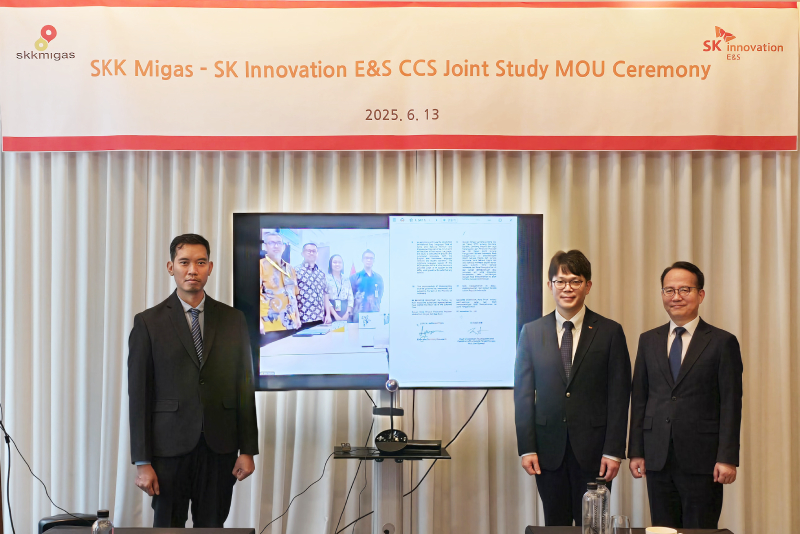
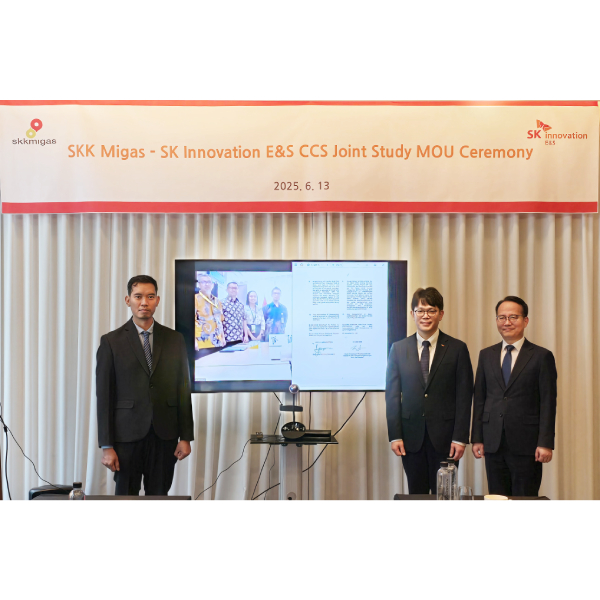
On June 13 (KST), SK Innovation E&S and Indonesia’s Special Task Force for Upstream Oil and Gas Business Activities (SKK Migas) held a ceremony at the Fairmont Ambassador Hotel in Yeongdeungpo, Seoul, South Korea, to mark the signing of a memorandum of understanding (MOU) for a Korea-Indonesia Cross-border CCS Joint Study.
The ceremony was facilitated by the “K-CCUS International Conference 2025,” held on June 12. It took place immediately after bilateral talks between South Korea’s Ministry of Trade, Industry and Energy and Indonesia’s Ministry of Energy and Mineral Resources (MEMR), with officials from both governments in attendance.
Under the terms of the MOU, SK Innovation E&S and SKK Migas will conduct a joint study into the feasibility of transporting and storing carbon dioxide (CO2) captured in South Korea to Indonesia. The study will analyze previous cross-border CCS projects that advanced rapidly after the final investment decision (FID) in regions like Europe. It will also involve a comprehensive review of international laws and regulations, as well as the identification of key tasks for establishing a bilateral agreement between the two countries.
To execute the joint study, SK Innovation E&S and SKK Migas have formed a joint working group and an operations committee, aiming to accelerate cooperation on CCS projects in the future.
CCS technology, which involves capturing CO2 and injecting it for permanent storage into depleted oil and gas fields or saline aquifers, is recognized as a practical solution for achieving global carbon neutrality goals. For South Korea, where suitable geological formations for large-scale CO2 storage are limited, pursuing cross-border CCS projects to export captured CO2 to other countries is essential.
This MOU is expected to catalyze cross-border CCS collaboration with Indonesia, a country identified as having significant potential CO2 storage sites. Indonesia is estimated to have the largest carbon storage capacity in Southeast Asia, with approximately 573 billion tons in saline aquifers and 5 billion tons in depleted oil and gas fields.
The Indonesian government has set a goal to achieve carbon neutrality by 2060, designating CCS as a key national strategy for emission reduction. Recently, it has been actively laying the groundwork for the commercialization of CCS and cross-border CO2 storage through regulatory updates, including Presidential Decree 14/2024. This reflects a strong commitment to nurturing the cross-border CCS industry.
Furthermore, the MOU is expected to serve as a catalyst for formalizing cooperation between companies in both countries, paving the way for comprehensive discussions on cross-border CCS initiatives.
Luky Agung Yusgiantoro, Executive Secretary of SKK Migas, stated, “The collaboration on cross-border CCS through this MOU will provide valuable insights for both countries. Ultimately, we hope Indonesia will become a hub for CCS in the Asia-Pacific region, strengthening practical cooperation between our nations.”
Kim Il-yung, Head of Upstream Development and Operations at SK Innovation E&S, remarked, “Cross-border CCS is essential for nations and companies to achieve their greenhouse gas reduction and carbon neutrality goals. Through this joint study, we aim to solidify a strategic partnership with Indonesia in the field of CCS.”
[Photo] Attendees pose for a commemorative photo at the ceremony for the “Korea-Indonesia Cross-Border CCS Joint Study MOU” held on June 13 at the Fairmont Ambassador Hotel in Yeongdeungpo, Seoul, South Korea. From left: Dwi Adi Nugroho, Deputy Director for Unconventional Oil and Gas Development, Indonesia’s Ministry of Energy and Mineral Resources (MEMR); Kim Il-yung, Head of Upstream Development and Operations at SK Innovation E&S; and Seo Seong-tae, Director of Energy Technology Division, Ministry of Trade, Industry and Energy of Korea.