■ Develops high-density large single-crystalline cathodes through novel synthesis method
■ Joint research with Seoul National University published in the Nature Energy
■ Test shows improvements in battery cycle life, stability, and energy density
SEOUL ─ SK On, a leading global battery solutions company, announced today a major advancement in next-generation cathode materials research, solidifying as its technological leadership in the battery sector.
SK On, part of South Korea’s SK Group, said it has succeeded in developing a high-density, large single-crystalline cathode electrode in collaboration with Professor Kisuk Kang’s research team at Seoul National University.
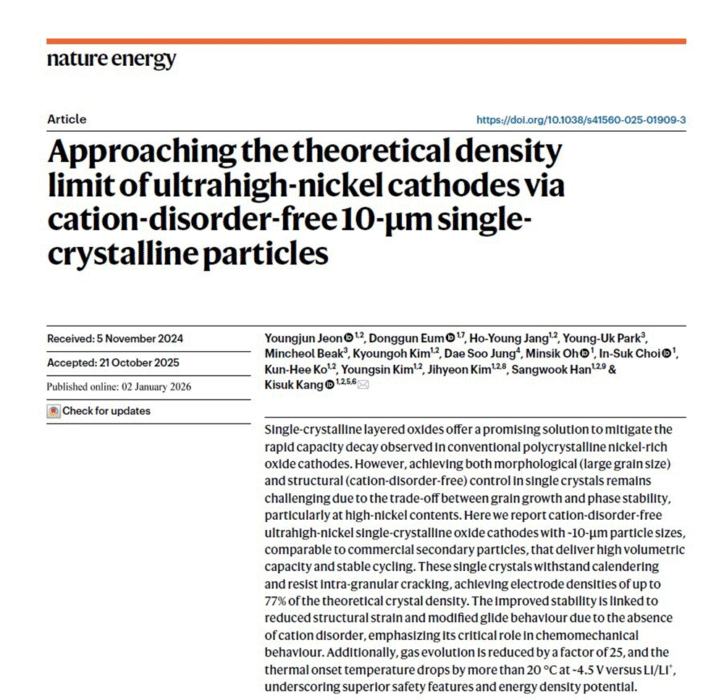
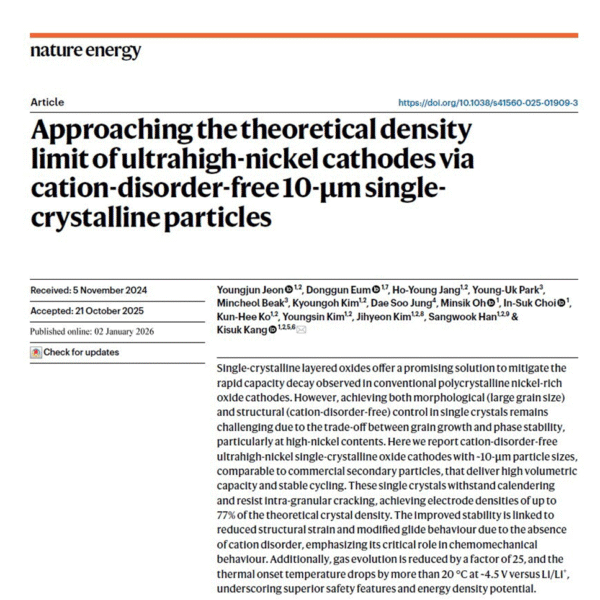
The study, published in the renowned academic journal “Nature Energy,” addresses technological barriers to synthesizing single-crystalline cathode materials and introduces a novel synthesis method, marking a significant step forward in advancing battery cycle life, stability, and energy density.
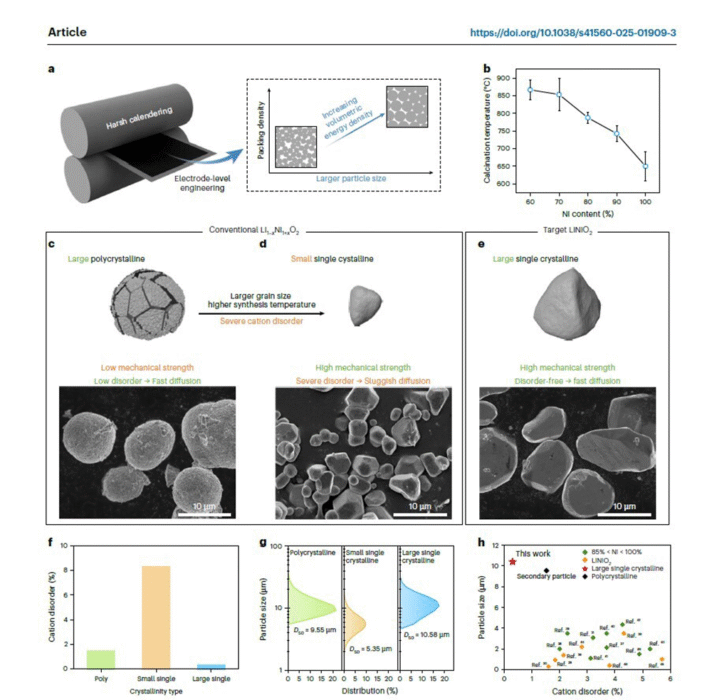
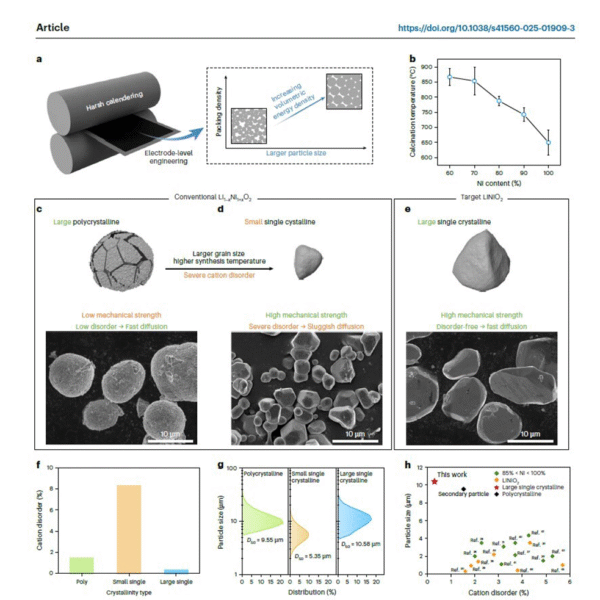
Polycrystalline cathode materials currently used in the industry are made up of multiple crystals grouped together within each particle. During calendering processes or charge/discharge cycles, the boundaries between these crystals can lead to cracking and generate gases.
In contrast, single-crystalline cathode materials consist of particles that are each formed as a single crystal, making them less prone to cracking and giving them superior stability and cycle life.
However, synthesizing single-crystalline cathode materials that achieve both large particle size and structural stability has been a major challenge. This is particularly true for high-nickel cathode materials, which require high-temperature, long-duration heat treatment to form single crystals—a process that can lead to cation disorder* and, consequently, reduced battery performance and cycle life.
To address these challenges, researchers from SK On and Seoul National University proposed a novel synthesis method.
First, they created single-crystalline sodium-based cathode materials, which offer superb structural stability and facilitate easier crystal growth. Then, through an ion-exchange process, the sodium ions were replaced with lithium ions, resulting in a high-quality cathode material that preserves the solid single-crystalline structure.
The researchers also analyzed the structural formation mechanisms and optimized synthesis conditions—including chemical composition, temperature, and time—to develop single crystalline cathode materials that enable high energy density.
As a result, they successfully synthesized cation-disorder-free ultrahigh nickel** single-crystalline cathodes composed of 10-micrometer(μm) particles, which are about twice the size of conventional cathode material particles.
This single-crystalline cathodes demonstrated outstanding mechanical and chemical stability, along with high energy density. Test results showed that, due to the absence of cation disorder, they experienced reduced structural strain, generated 25 times less gas compared to conventional polycrystalline cathodes, and achieved an energy density of up to 77 percent of the theoretical crystal density***.
Researchers at SK On and Seoul National University will continue follow-up studies to further advance next-generation cathode materials. Building on these results, they plan to explore more advanced material compositions and synthesis techniques.
The researchers are also planning combining single-crystal particles of different sizes in optimal ratios to further enhance energy density.
“This research clearly demonstrates SK On’s technological competitiveness in battery materials,” said Dr. Kisoo Park, Head of the Future Technology Institute at SK On. “We will continue to strengthen our technological leadership through innovative research and development with academia.”
*Cation disorder: Due to the similar size of lithium and nickel ions in nickel-based cathode materials, these ions deviate from their designated layers (lithium layer, nickel layer) and become intermixed.
**Ultrahigh nickel: Refers to cathode materials containing more than 94% nickel content. Higher nickel content increases energy density, which extends the driving range of electric vehicle batteries on a single charge.
***Theoretical crystal density: The maximum possible density assuming a perfect crystal structure with no defects, voids, or impurities.
[Photos]
(Photo 1,2) Joint research by SK On and Seoul National University on high-density single-crystalline cathode materials, published in Nature Energy