Charging Time: A Key Challenge for EVs
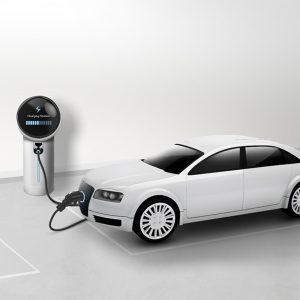
Unlike internal combustion engine vehicles, which can be refueled in just a few minutes, electric vehicles can take anywhere from tens of minutes to several hours to charge, depending on charging method and power level. Charging convenience and speed remain key factors causing consumers to hesitate when purchasing EVs. According to the International Energy Agency’s Global EV Outlook 2025, global EV sales continue to grow, alongside the expansion of public charging infrastructure. However, infrastructure alone is not enough to address the fundamental challenge of long charging times. PwC, a global consulting firm, reported in its eReadiness 2025 study that about half of prospective EV buyers cite charging time as a key consideration. Against this backdrop, EES Batteries, a journal published by the Royal Society of Chemistry (RSC), has highlighted fast-charging technology targeting an 80% charge in under 10 minutes as a key area of research in the EV battery field. With charging speed improvements emerging as a key determinant of industry competitiveness, automakers and battery makers are concentrating on fast-charging technologies enabled by battery cell design.
Electrochemical Limits of Fast Charging
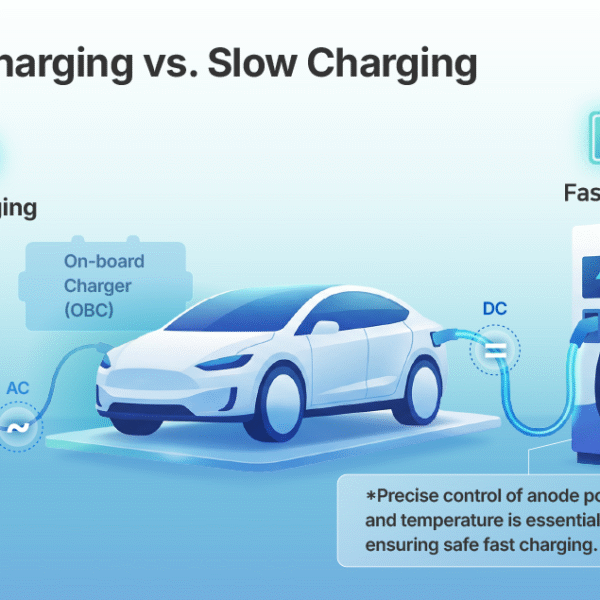
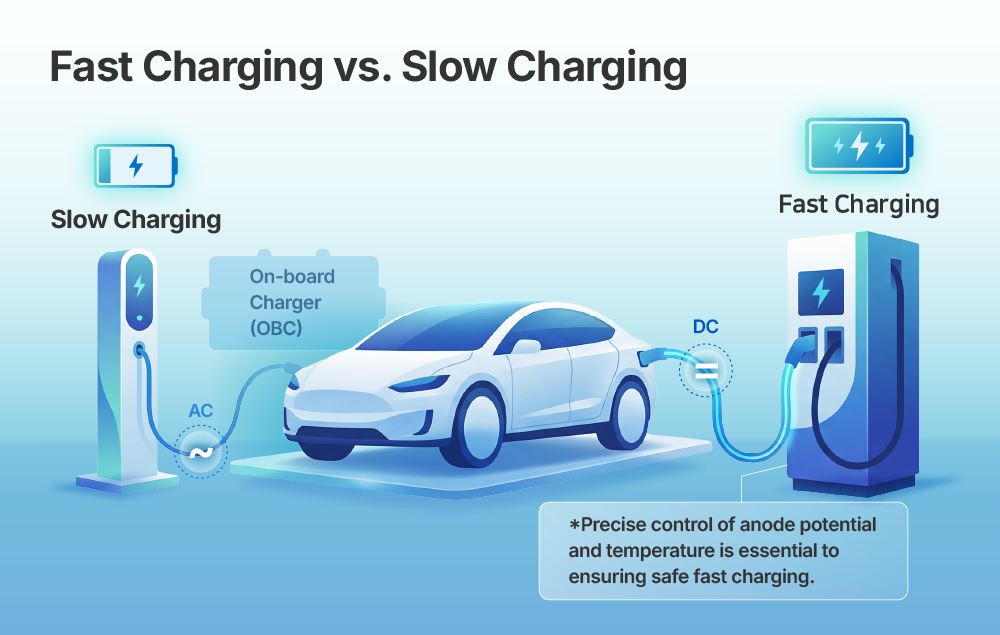
What is fast charging? It is a technology that shortens charging time by increasing voltage and current to rapidly deliver power. It is also commonly defined as charging a battery from a state of charge (SoC) of 10% to 80% within a short period of time.
While slow charging delivers energy over a long time at low power, fast charging delivers energy in a short time at high power. As current increases, charging speed improves, but the internal reaction conditions of the battery also change. In lithium-ion batteries, lithium ions released from the cathode during charging move through the electrolyte to the anode. They are then inserted into the anode active material, where the energy is stored. The active material is the core material that stores or releases lithium ions and drives electrochemical reactions.
However, the situation is different under fast-charging conditions. At high current, electrons are supplied to the anode very rapidly, but lithium ions cannot be inserted into the active material at the same rate. As a result, some lithium ions are reduced to metallic lithium and remain on the anode surface. This phenomenon is known as lithium plating, and when repeated, it can lead to a loss of battery capacity.
At the same time, higher current also generates more heat. As temperature rises, the solid electrolyte interphase (SEI) layer on the anode surface becomes non-uniform and degrades, leading to increased internal resistance and reduced battery lifespan. Ultimately, fast charging is not simply about increasing current but managing risks such as lithium plating and SEI degradation during the charging process. To achieve this, stable fast charging requires a design that minimizes anode resistance and precisely controls anode potential and temperature.
From 18 to 7 Minutes
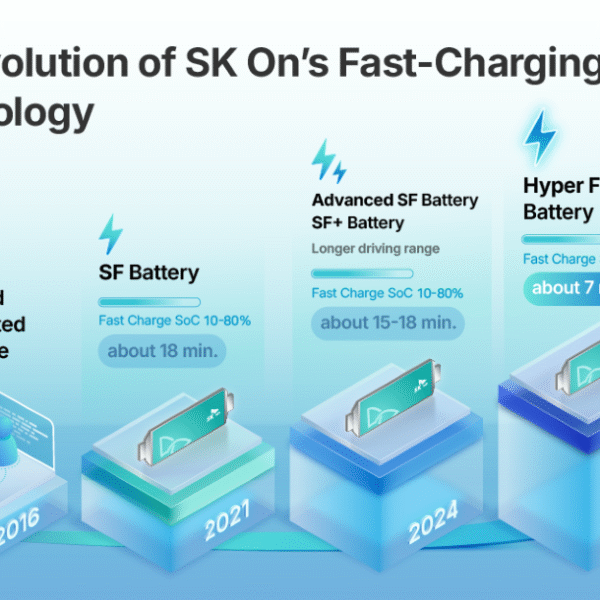
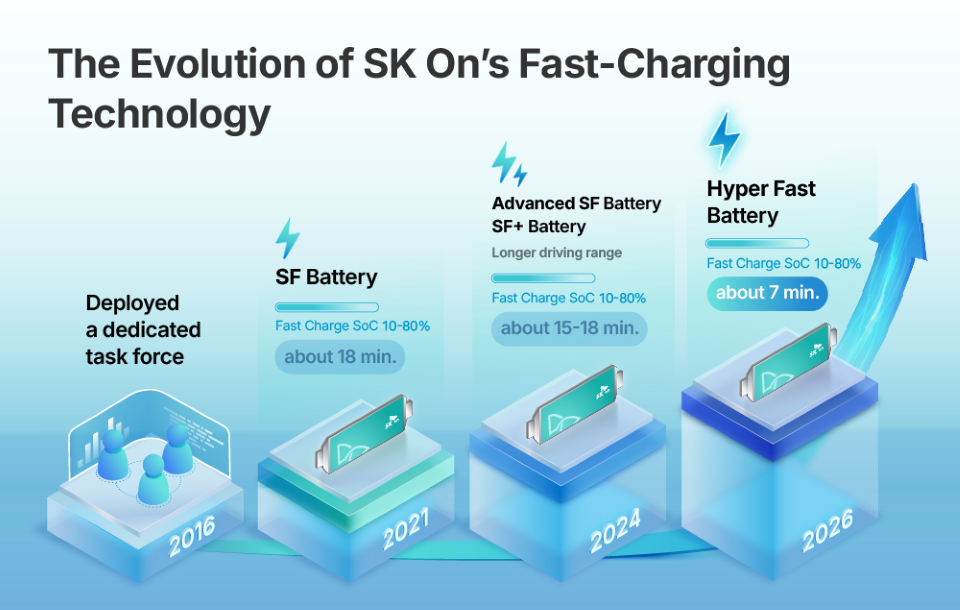
To address these technical challenges, SK On has run a dedicated task force since 2016 and has systematically advanced its fast-charging technologies. The SF Battery, unveiled in 2021, achieved fast charging in 18 minutes by applying dual-layer coating technology. At CES 2023, the world’s largest consumer electronics and IT exhibition, it became the first in the Korean battery industry to win the Best of Innovation.
In 2024, SK On introduced the SF+ Battery, which reduced fast-charging time to 15 minutes. By incorporating a dual-layer structure with high-capacity silicon and low-resistance graphite, it shortened the lithium-ion transport distance while increasing transport speed.
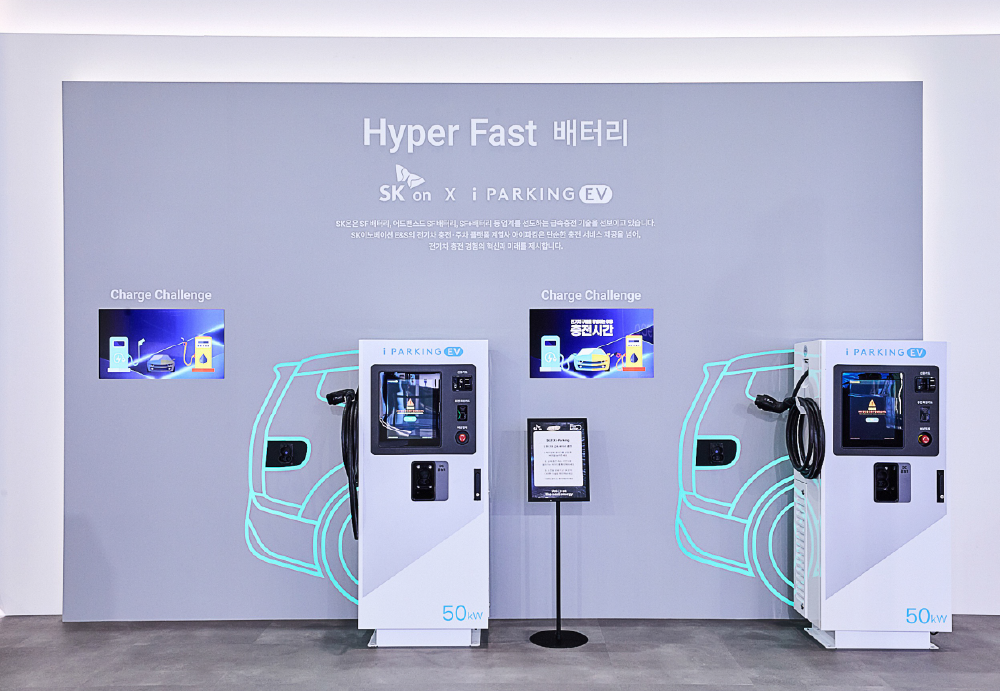
The company also unveiled the Advanced SF Battery, which incorporates a magnetic alignment process*. This technology improved energy density by 8% compared to the original SF Battery while maintaining fast-charging performance. Building on this technological evolution, SK On unveiled its Hyper Fast Battery technology at InterBattery 2026 in March this year, demonstrating charging from 10% to 80% SoC in under seven minutes.
*Magnetic alignment process: A technology that shortens the lithium-ion transport path by vertically aligning graphite particles within the anode.
How Integrated Electrode and Charging Design Made Seven-Minute Charging Possible
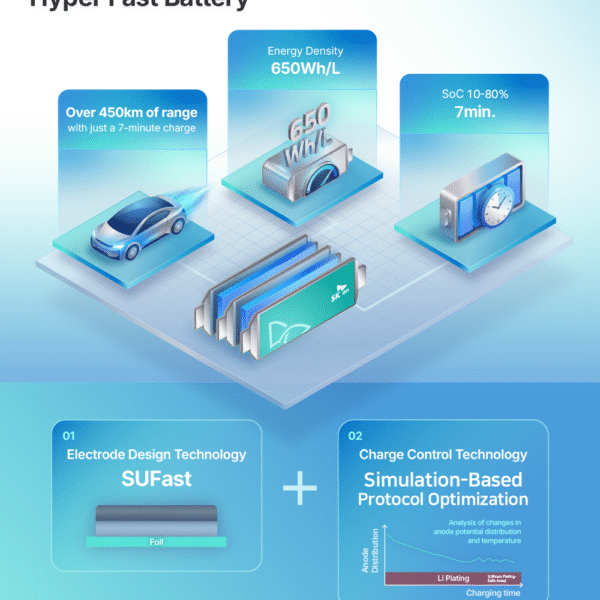
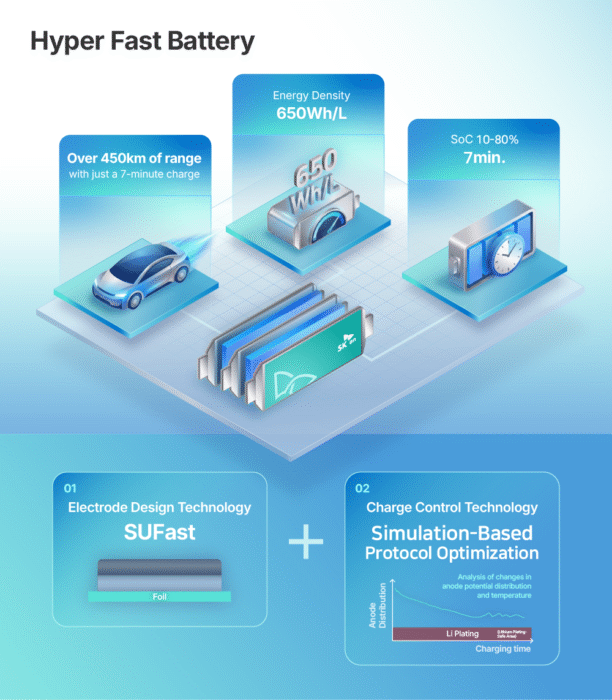
The Hyper Fast Battery enables a driving range of over 450km with a charge of just seven minutes. This is enough to travel from Paris to Brussels. Even a three-minute charge — comparable to the refueling time of internal combustion engine vehicles — can provide an additional driving range of about 200km. In general, higher energy density leads to longer driving range. However, as discussed earlier, increasing energy density can also result in higher anode resistance and reduced battery life under fast-charging conditions. Despite this trade-off, SK On has achieved both high energy density — 650Wh/L — and fast charging by combining two key technologies: SUFast (SUper-Fast) and simulation-based protocol optimization.
1) Electrode Design Technology: SUFast
To enable fast charging, lithium ions must be inserted rapidly from the electrode surface into the anode. However, a phenomenon known as binder migration — where binder moves toward the electrode surface during the drying of an electrode slurry — can limit this process. When binder accumulates on the surface, it restricts lithium-ion transport pathways and increases anode resistance.
SUFast is an electrode design technology that precisely controls the formulation and distribution of binder and solvent. It applies a dual-layer coating process in which slurry is coated onto the foil twice, optimizing the composition of the upper and lower layers to suppress binder migration. This approach lowers anode resistance and stabilizes lithium-ion insertion, reducing the risk of lithium plating during fast charging while also establishing a cell design that enables fast charging by addressing the trade-off between high energy density and anode resistance.
2) Charging Control Technology: Simulation-Based Protocol Optimization
While electrode design improves the anode structure, it is also necessary to maintain control over reaction conditions during charging. For this purpose, SK On used multiphysics simulations to analyze changes in anode potential distribution and temperature under varying current conditions. Based on these results, a safe potential range in which lithium plating does not occur is defined as a threshold, and optimal current protocols are designed for each SoC range. This current control helps manage heat generation during fast charging and minimizes degradation of the solid electrolyte interphase (SEI) layer. At the same time, it suppresses lithium plating, ensuring stable battery life. Fast charging is not simply about applying high power, however — it also requires predicting internal cell reactions and precisely controlling potential and temperature. In this sense, simulation-based protocol optimization is industrially significant because it makes fast charging a predictable and controllable technology.
Roadmap Toward Commercialization
SK On plans to validate mass-production feasibility through pilot line testing in 2027, while pursuing phased commercialization with start of production (SOP) targeted for 2029. SUFast is implemented by adjusting slurry composition using existing dual-layer coating equipment. Combined with simulation-based protocol optimization, the Hyper Fast Battery can be produced on existing mass-production lines without large-scale facility investment. This enhances its commercialization potential by reflecting both charging performance and manufacturability in the design.
A New Standard for Fast Charging
SK On’s integrated design mitigates battery life degradation during fast charging while improving charging speed and safety. The Hyper Fast Battery, which combines electrode design with charging control technology, takes fast-charging technology a step further. By reducing charging time, it is expected to enhance the EV user experience and accelerate broader adoption. In the next article, we will explore the prismatic On-vent Cell — another key element of SK On’s technology roadmap — and how it enhances battery safety through design.
■ Related articles

- [Battery Deep Dive] Part 1: Solid-State Batteries

- [Battery Deep Dive] Part 2: Thermal Propagation Prevention

- [Battery Deep Dive] Part 3: The Dry Electrode Process

- [Battery Deep Dive] Part 4: Cell-to-Pack Technology