💡 Key Takeaways
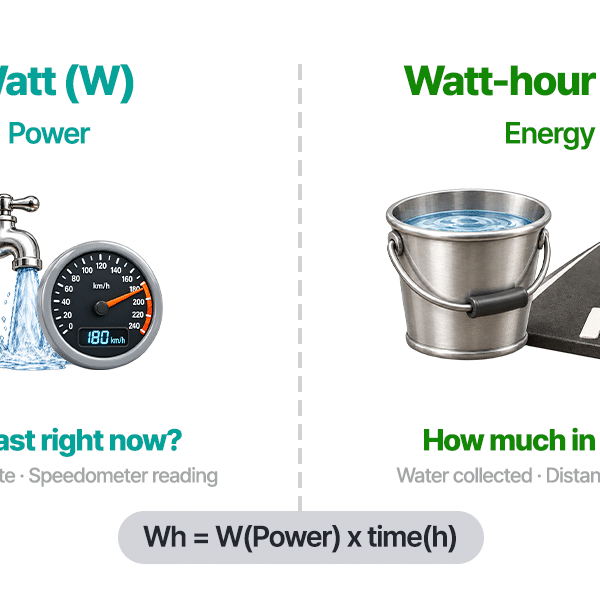
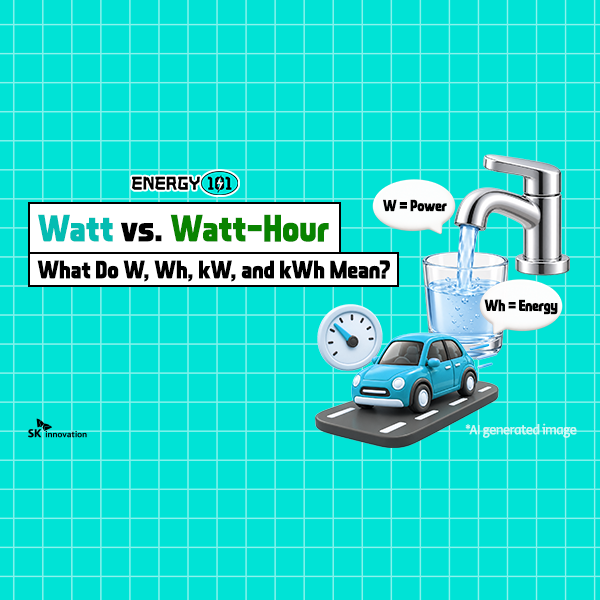
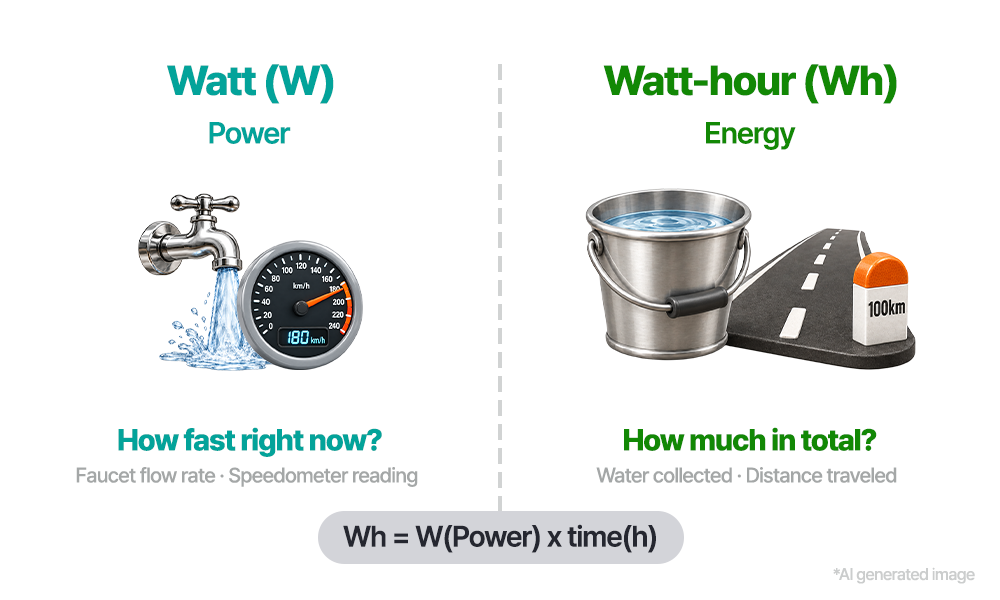
- A watt (W) measures power — how fast electricity is being used right now. It is the strength of the stream from a faucet, or a car’s speed on the speedometer.
- A watt-hour (Wh) measures energy — how much electricity has been used in total. It is the water collected in the bucket, or the distance shown on the same car’s odometer.
- One formula connects them: Wh = W × h. This is why the kWh on an electricity bill and the Wh of a battery are both accumulated values.
- In one line: W is “how fast right now,” Wh is “how much in total.”
What Are Watts and Watt-Hours?
A watt (W) is a unit of power — the rate at which electricity is used or produced at a given instant. A watt-hour (Wh) is a unit of energy — the total amount of electricity used over a period of time. The two are linked by a single formula:
| Energy (Wh) = Power (W) × Time (h) |
A watt is a snapshot; a watt-hour is an accumulation.
This single distinction explains nearly every electricity number consumers encounter. A microwave is rated at 1,000 W. A power bank is labeled 10,000 mAh, or 37 Wh. An electricity bill shows 350 kWh. An electric vehicle is advertised with a 77 kWh battery. All of these are either a measure of how fast or a measure of how much — nothing else.
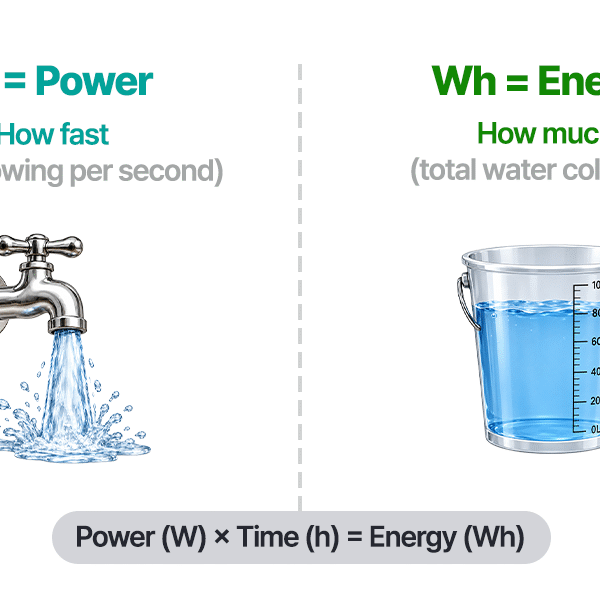
The Faucet: Power Is the Stream, Energy Is the Bucket
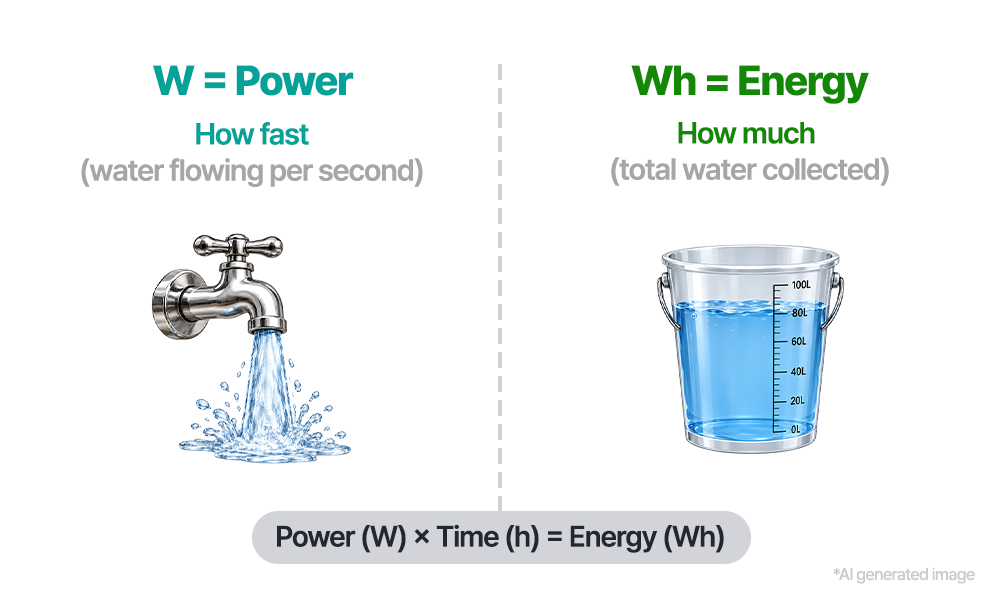
Imagine filling a bucket in a bathroom sink.
| Faucet | Electricity |
|---|---|
| How far the faucet is opened (water flowing per second) | Watt (W) — the rate at which electricity is used |
| Total water collected in the bucket | Watt-hour (Wh) — the amount of electricity used |
• Open the faucet wide → high flow rate (W) → the bucket fills quickly
• Open it to a trickle → low flow rate (W) → the bucket fills slowly
Now the key question: how much water is in the bucket?
The flow rate alone cannot answer this. The duration must also be known.
Water collected = flow rate × time the faucet was open
Electricity used (Wh) = power (W) × time (h)
The name “watt-hour” contains the formula: it is literally watts multiplied by hours.
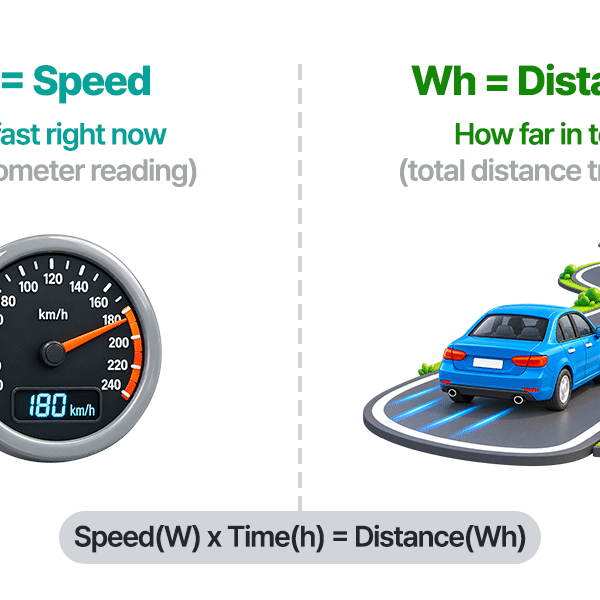
The Car: Speed vs. Distance
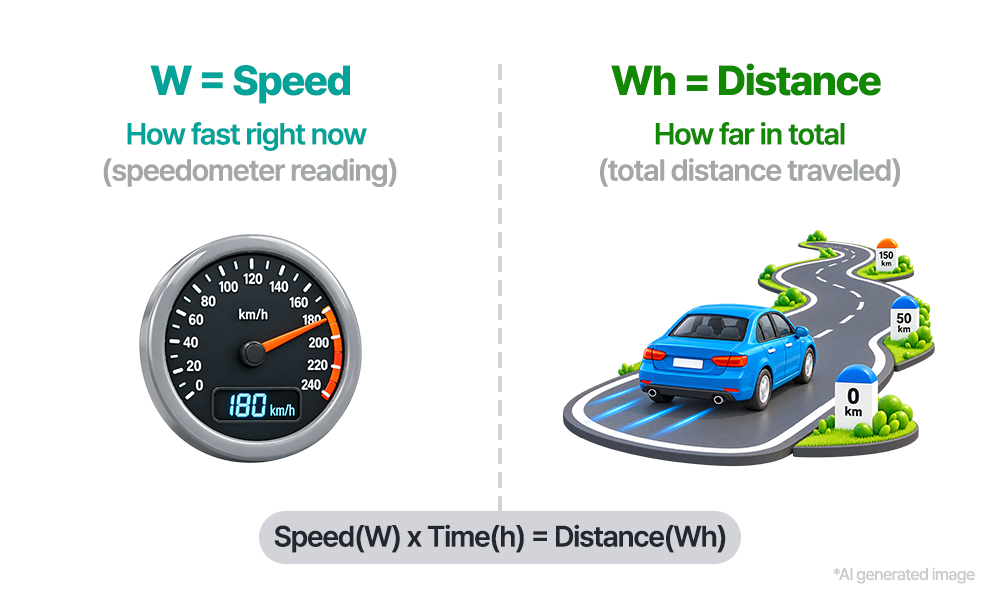
• W = the speedometer reading (km/h) → how fast, right now
• Wh = the odometer reading (km) → how far in total
A car traveling at 60 km/h for 2 hours covers 120 km. A 600 W fan running for 2 hours consumes 1,200 Wh (1.2 kWh). The structure is identical.
speed (km/h) × time (h) = distance (km)
power (W) × time (h) = energy (Wh)
• 200 km/h for 1 minute → about 3.3 km
• 30 km/h for 3 hours → 90 km
The much faster car traveled far less. Fast does not mean far — and in the same way, a high wattage does not mean high consumption.
*Units here are metric; the relationship is identical in miles per hour and miles.
Worked Examples
① A 1,000 W microwave running for 6 minutes
6 minutes = 0.1 hour
1,000 W × 0.1 h = 100 Wh
A high rate, but a short time — so the total is small.
② A 10 W LED bulb running for 10 hours a day
10 W × 10 h = 100 Wh
Six minutes of microwave equals ten hours of LED lighting. The power rating differs by a factor of 100, yet the energy consumed is the same. This is precisely why the two units cannot be used interchangeably.
③ Electricity is billed in energy, not power
Residential electricity bills are based on total energy consumed, measured in kilowatt-hours (kWh), where 1 kWh = 1,000 Wh.
- A 1,500 W air conditioner, 5 hours a day, 30 days → 1.5 kW × 5 h × 30 days = 225 kWh
That is how the number on a monthly bill is produced.
Common Mistakes
① “This power bank is 20,000 W.” — Incorrect
Capacity is an amount, so it must be stated in Wh (or milliamp-hours, mAh). A 20,000 mAh power bank is typically about 74 Wh.
To convert: Wh = mAh × voltage (V) ÷ 1,000. At a nominal cell voltage of 3.7 V, 20,000 mAh × 3.7 V ÷ 1,000 ≈ 74 Wh. Note that mAh alone is not a complete capacity figure, because it says nothing about voltage.
② Calling an EV battery “77 kW” instead of “77 kWh.” — Incorrect
A battery stores energy, so its size is stated in kilowatt-hours. A 77 kWh pack holds 77 kilowatt-hours of energy.
The same car also carries meaningful kW figures — they simply describe different things:
| Figure | What it describes |
| 77 kWh | Battery capacity — how much energy is stored |
| 150 kW | Motor output — how fast the car can drive |
| 350 kW | Maximum charging rate — how fast energy goes in |
Charging shows the formula at work. An 11 kW home charger delivers about 11 kWh each hour, so filling a 77 kWh pack from empty takes roughly 7 hours (77 kWh ÷ 11 kW = 7 h). Real charging takes longer, because the rate slows as the battery approaches full.
③ “A 100 W appliance uses a lot of electricity.” — Incomplete
A power rating alone settles nothing. Only after multiplying by running time does consumption become meaningful.
④ Writing “kW/h” instead of “kWh.” — Incorrect
A kilowatt-hour is a kilowatt multiplied by an hour, not divided by one. “kW/h” describes a rate of change in power — a different quantity entirely, and almost never what is intended.
Summary Table
| Watt (W) | Watt-hour (Wh) | |
|---|---|---|
| Quantity | Power — the rate of electricity use | Energy — the amount of electricity used |
| Faucet | How far the faucet is opened | Water collected in the bucket |
| Car | Speed (km/h) | Distance traveled (km) |
| Relation to time | Independent of time (instantaneous) | Includes time (accumulates) |
| Where it appears | Appliance ratings, motor output, plant capacity | Electricity bills, battery capacity |
| Formula | W = Wh ÷ h | Wh = W × h |
Unit Prefixes
| Prefix | Power | Energy |
|---|---|---|
| kilo (k) | 1 kW = 1,000 W | 1 kWh = 1,000 Wh |
| mega (M) | 1 MW = 1,000 kW | 1 MWh = 1,000 kWh |
| giga (G) | 1 GW = 1,000 MW | 1 GWh = 1,000 MWh |
The same distinction holds at every scale. A grid-scale battery described as “10 MW / 20 MWh” is stating its power first and its energy second — two different specifications, not one repeated.
★ FAQs
Q. What is the difference between kW and kWh?
kW measures power — the rate of electricity use at a given moment. kWh measures energy — the total consumed over time. The relationship is kWh = kW × hours. A 2 kW heater running for 3 hours consumes 6 kWh.
Q. Is “kW/h” a valid unit?
No, not for ordinary use. A kilowatt-hour (kWh) is a kilowatt multiplied by one hour. “kW/h” would mean kilowatts per hour — a rate of change in power — which is rarely the intended meaning. The correct notation is kWh.
Q. How do I convert mAh to Wh?
Multiply milliamp-hours by voltage and divide by 1,000: Wh = mAh × V ÷ 1,000. A 10,000 mAh power bank at a nominal 3.7 V is about 37 Wh. Because voltage varies between products, mAh figures are only comparable at the same voltage.
Q. Which unit do airlines use for lithium battery limits?
Airline carry-on limits for lithium batteries are based on watt-hours (Wh), not watts. Under the international standards most carriers follow, batteries up to 100 Wh are generally permitted in carry-on baggage without approval, and those between 100 Wh and 160 Wh typically require airline approval. Rules and enforcement vary by airline and country, so confirm with your carrier before traveling.
Q. Why is a power plant rated in GW but its output reported in GWh?
GW describes the plant’s maximum instantaneous output — its capacity. GWh describes how much electricity it actually generated over a period. A 1 GW plant running at full output for 24 hours generates 24 GWh; the same plant running at partial load generates less, while its capacity rating stays the same.
📖 Glossary
| Term | Definition |
|---|---|
| Power | The rate at which energy is transferred, converted, or used. Measured in watts (W). |
| Energy | The capacity to do work; in electricity, the total amount used or delivered over a period of time. The SI unit is the joule (J), but watt-hours (Wh) are used in practice. |
| Watt (W) | The SI unit of power, equal to one joule per second. |
| Kilowatt (kW) | 1,000 watts. The usual unit for appliance ratings, motor output, and charging rates. |
| Watt-hour (Wh) | The energy transferred by one watt of power sustained for one hour; equal to 3,600 joules. |
| Kilowatt-hour (kWh) | 1,000 watt-hours, or 3.6 megajoules. The unit in which household electricity use is billed. |
| Joule (J) | The SI unit of energy. One joule is one watt sustained for one second; 1 Wh = 3,600 J. |
| Milliampere-hour (mAh) | A measure of electric charge, commonly used for battery capacity. Converts to watt-hours only when the voltage is known. |
| Voltage (V) | The electrical potential difference that drives current. Power is voltage multiplied by current: W = V × A. |
| Nameplate capacity | The maximum output a generator or device is designed to deliver under ideal conditions, stated in W, kW, MW, or GW. It is a power rating, not an energy rating. |
■ Related Articles

- SK On Demonstrates ESS Fire Safety in Large-Scale Fire Test

- [Energy’s Plot Twist] “Use More, Lose More?” With ESS, It’s the Opposite! The Structure and Advantages of LFP Batteries for ESS

- Vampire Power, Zombie Servers, and the Data Centers That Never Sleep