Proprietary catalyst published in the Royal Society of Chemistry’s Journal of Materials Chemistry A outperforms commercial benchmarks and withstands the power swings of renewable energy
💡 Key Takeaways
- Proprietary catalyst, peer-reviewed. SK Innovation’s Institute of Environmental Science & Technology developed a water electrolysis catalyst independently, published in Journal of Materials Chemistry A of the UK’s Royal Society of Chemistry.
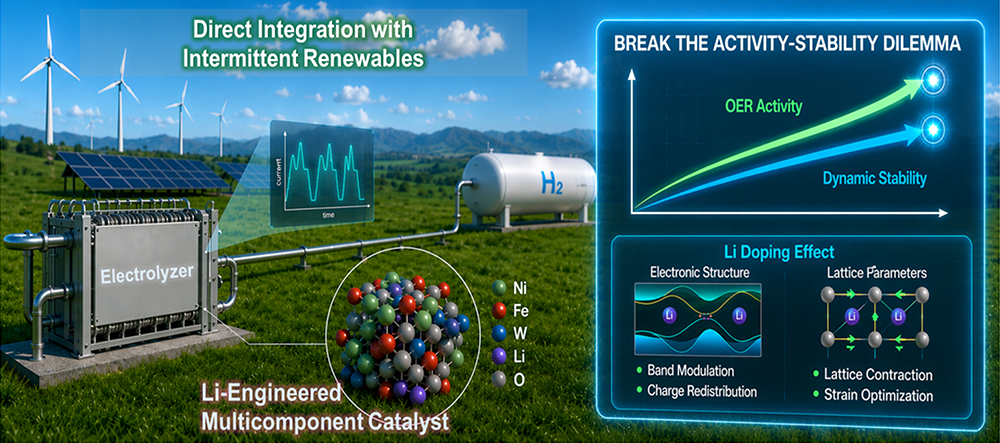
- Lithium engineering tackles a long-standing trade-off. A trace of lithium raises both hydrogen production efficiency and catalyst durability at once — holding up across 5,400 start-up and shutdown cycles that simulate fluctuating renewable power.
- Full-chain e-SAF patents secured. SK Innovation now holds patented technology at every stage of e-SAF manufacturing, strengthening its position in next-generation low-carbon aviation fuel.
SK Innovation today announced a water electrolysis catalyst that produces green hydrogen efficiently and durably under the intermittent, fluctuating power typical of wind and solar generation — a long-standing challenge in operating electrolyzers on variable renewable power.
Developed by the company’s Institute of Environmental Science & Technology, the catalyst has been published in Journal of Materials Chemistry A, a peer-reviewed journal of the Royal Society of Chemistry ranked in the top quartile of materials and energy journals worldwide.
The green hydrogen it produces is the primary feedstock for e-SAF, a sustainable aviation fuel synthesized from green hydrogen and captured CO₂ that can be blended with conventional jet fuel and burned in today’s aircraft and airport infrastructure without modification.
The challenge: Performance and durability at once
Anion-exchange membrane water electrolysis (AEMWE) is a promising technology for scalable green hydrogen production using renewable electricity, with the potential to reduce reliance on precious-metal catalysts. Despite its promise, AEMWE still faces a challenge at the anode, where the oxygen-producing reaction proceeds slowly and takes place under highly oxidizing conditions.
As renewable power fluctuates, electrolyzers may experience frequent changes in operating power and repeated start-up and shutdown cycles, which can accelerate catalyst degradation and metal dissolution. This makes it difficult to achieve both high performance and long-lasting durability: catalysts that drive the reaction quickly may degrade faster, while more durable catalysts may not deliver the required performance. Developing catalysts that are both efficient and durable under changing operating conditions is an important step toward wider commercialization of AEMWE.
The solution: a trace of lithium, two effects at once
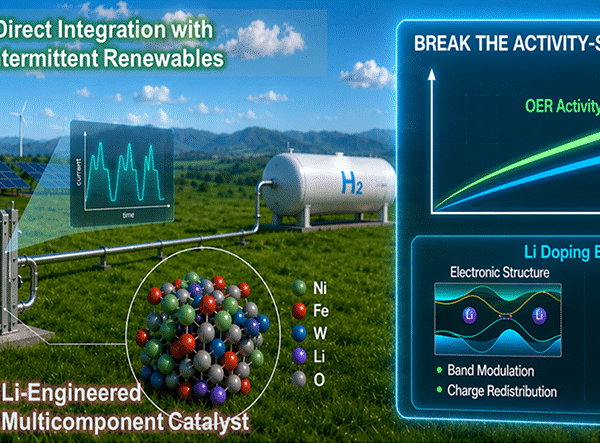
SK Innovation’s researchers approached this by engineering a trace amount of lithium into a nickel–iron–tungsten (Ni–Fe–W) oxide, yielding a Li-engineered Ni-rich multicomponent catalyst (Ni–Fe–W–Li).
Density functional theory calculations and experimental observations showed that lithium incorporation plays a bifunctional role. It strengthens Ni–O covalency and charge transfer, activating the fast lattice-oxygen mechanism (LOM) — and it strengthens hydroxide adsorption, so the oxygen vacancies generated by that mechanism are refilled almost as quickly as they form. Replenishing those vacancies is what suppresses metal dissolution and structural collapse, converting a normally destabilizing high-activity pathway into a durable one.
Validated at device scale
In a 5 cm² zero-gap membrane electrode assembly (MEA), the Ni–Fe–W–Li anode required 1.70 V at 2 A cm⁻² and 1.78 V at 3 A cm⁻², compared with 1.76 V and 1.88 V for a commercial RuO₂ benchmark — a widening margin as current density rises, where real electrolyzers operate.
Durability was tested against renewable-like duty cycles rather than steady current alone. The catalyst degraded by just 0.58 mV per cycle across 5,400 start-up and shutdown cycles and 0.35 mV per cycle across 2,700 staircase current-ramp cycles, with negligible decay over 500 hours of continuous operation.
Completing the e-SAF chain
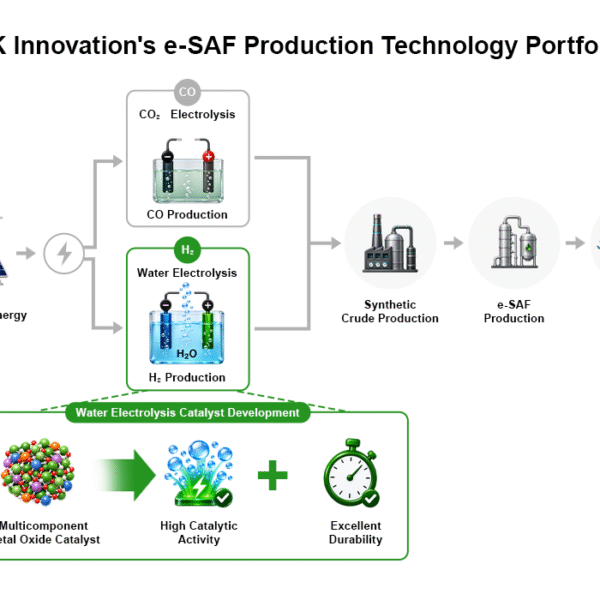
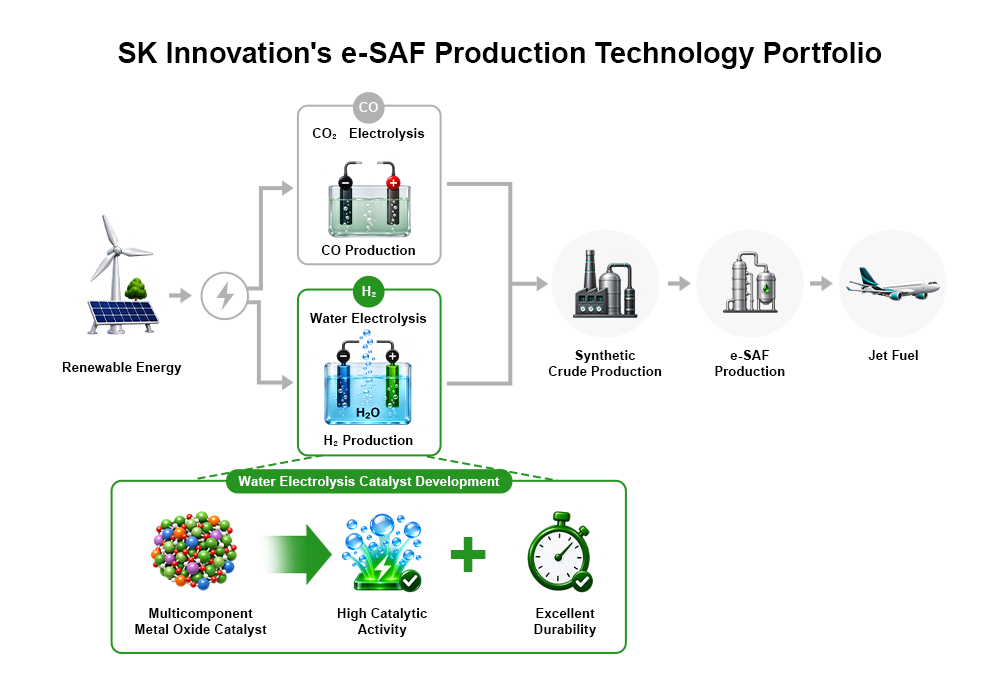
Green hydrogen is the entry point to a four-step pathway. CO2 captured from the atmosphere and other eligible sources is electrochemically reduced to carbon monoxide; the CO is combined with green hydrogen to form syngas; the syngas is converted into synthetic crude; and the synthetic crude is refined and upgraded into jet-grade e-SAF.
With this result, SK Innovation holds patented technology at every stage of that chain — water electrolysis, CO2 electrolysis, synthetic crude synthesis, and e-SAF refining and conversion. The work also marks the company’s deliberate extension of the thermochemical catalysis expertise built over decades of refining and petrochemical operations into electrochemical manufacturing of value-added fuels and materials.
“This research extends the catalyst capability we built through energy and chemicals R&D into the electrochemical technologies that sustainable fuels will require,” said Philseok Kim, Chief Technology Officer of SK Innovation, who leads the company’s Institute of Environmental Science & Technology. “Building on our core strengths in catalysis, process engineering and synthesis, we will keep securing future clean energy technologies and help build the e-SAF ecosystem.”
Market context
The International Air Transport Association (IATA) projects global SAF output of roughly 2.4 million tonnes in 2026, against the approximately 500 million tonnes per year the aviation industry would need to reach net-zero by 2050. e-SAF is expected to supply more than 40% of global SAF production potential by mid-century.
About the research
Title: A Li-engineered multicomponent catalyst as a highly active and durable anode for dynamic AEM water electrolysis
Authors: Yun Ji Lim and Jiyun Lee (co-first authors), Hyunsu Han (corresponding author), Daehyun Choo (Institute of Environmental Science & Technology, SK Innovation Co., Ltd.)
Journal: Journal of Materials Chemistry A, Royal Society of Chemistry · DOI: 10.1039/d6ta08182g · Published Oct. 27, 2026
Read the paper: https://pubs.rsc.org/ta/article-abstract/doi/10.1039/d6ta08182g/1377095/A-Li-engineered-multicomponent-catalyst-as-a
[Images]
(Image 1) SK Innovation’s e-SAF Production Technology Portfolio
(Image 2) Graphical abstract. © 2026 The Author(s). Published by the Royal Society of Chemistry.