What is an ESS, how does it store and release electricity, and why is it drawing attention now? From storage principles to real-world applications.
💡 Key Takeaways
- An ESS (Energy Storage System) stores energy and supplies it again when needed. A BESS — a battery-based ESS — is the most common type, combining batteries with a BMS, PCS, EMS, and thermal and safety equipment.
- A BESS takes alternating current (AC) from the grid, converts it to direct current (DC) through a PCS, and stores it in batteries; when electricity is needed, it converts the power back to AC and sends it out. Round-trip efficiency (RTE) is the ratio of energy recovered during discharge to energy supplied during charging, typically 85–90% for utility-scale systems.
- Variable renewable output, rapid load swings at data centers, and delays in expanding power infrastructure are all driving demand for energy storage.
- ESS is deployed at renewable power plants, on transmission and distribution networks, at factories and data centers, and in homes. Because thermal stability, cycle life, and cost-effectiveness matter most in these applications, LFP has become the mainstream chemistry for ESS battery.
What is an ESS?
An ESS (Energy Storage System) is the combination of equipment and control systems that stores energy and supplies it again when needed.
A power grid has to match generation and demand in real time. When supply exceeds demand, output is curtailed or the surplus is stored; when supply falls short, generation is increased or demand is adjusted. An ESS takes part in this balancing act, bridging the gap between the time electricity is generated and the time it is used.
| Storage method | Form of stored energy | Key characteristics |
|---|---|---|
| Pumped-storage hydropower |
Gravitational potential energy of water | Used for large-capacity, long-duration storage. Site conditions such as elevation difference and reservoirs are decisive |
| Compressed air energy storage (CAES) |
Energy of compressed air | Compressed air is stored and later used for generation. Requires underground caverns or pressure vessels |
| Flywheel | Rotational kinetic energy | Very fast response, suited to short-term fluctuations. Not suited to long-duration storage |
| Thermal energy storage (TES) |
Thermal energy | Heat is used directly or for generation. Converting it back to electricity requires separate generating equipment. Large-scale underground thermal storage is also being researched |
| Battery energy storage system (BESS) |
Electrochemical energy | Fast charge and discharge, and modular configuration. Capacity, lifetime, and safety must be designed for the intended use |
Among these, the system that uses batteries as the storage medium is a BESS (Battery Energy Storage System). When industry and media say “ESS” today, they usually mean a BESS — but strictly speaking, ESS is the broader term, covering non-battery methods such as pumped-storage hydropower.
How does a BESS store and release electricity?
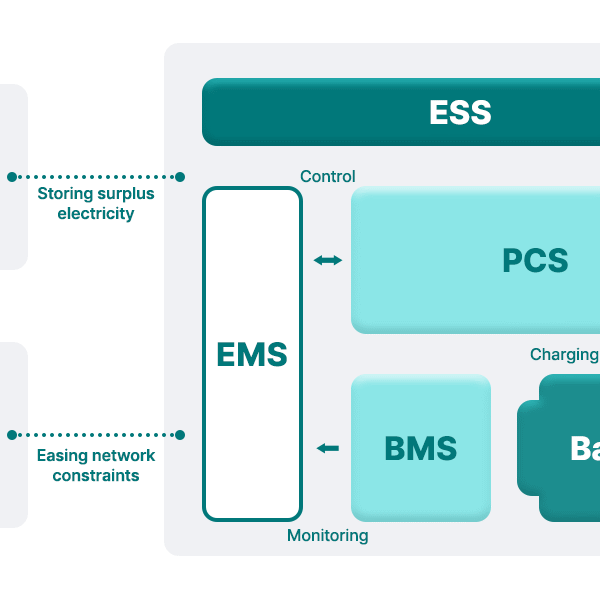
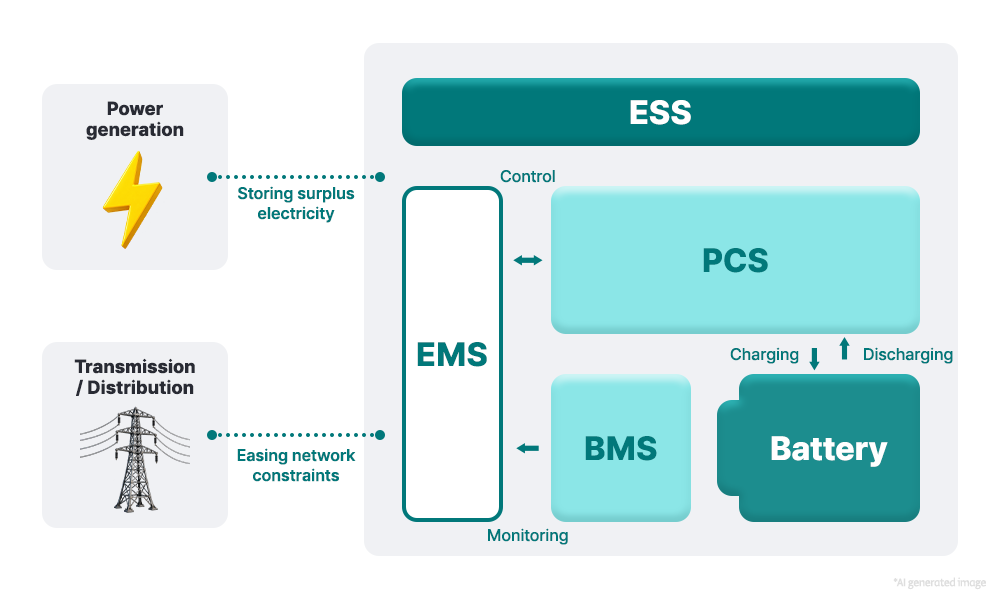
A battery energy storage system (BESS) stores electricity in batteries and supplies it when needed. Alternating current (AC) from the grid is converted to direct current (DC) by the power conversion system (PCS) and stored in the batteries; when electricity is required, the DC power in the batteries is converted back to AC and delivered to the grid. These two processes are called charging and discharging. The energy management system (EMS) decides when to charge and discharge based on electricity demand, tariffs, and battery condition, while the battery management system (BMS) monitors voltage, current, and temperature to keep the batteries within their safe operating range.
• Components of a BESS
| Component | Role |
|---|---|
| Battery | Cells are configured into modules, packs, racks, and containers to store and release energy |
| BMS (Battery Management System) |
Monitors voltage, current, and temperature, and estimates state of charge (SOC) and state of health (SOH). Keeps the battery within its safe operating range |
| PCS (Power Conversion System) |
Converts between alternating current (AC) and direct current (DC) in both directions |
| EMS (Energy Management System) |
Determines charge and discharge timing and operating plans, taking into account electricity demand, tariffs, grid instructions, and battery condition |
| Balance of plant | Thermal management such as air or liquid cooling, fire detection and suppression equipment, circuit breakers, transformers and switchboards. Configuration varies by installation type, such as containerized or indoor systems |
• Charge, discharge, and round-trip efficiency (RTE)
Not all of the electricity put into storage can be taken back out. Some power is lost during charging, discharging, and power conversion, and auxiliary equipment such as cooling also consumes electricity. Round-trip efficiency (RTE) is the ratio of energy recovered during discharge to energy supplied during charging. For utility-scale BESS, RTE is generally in the range of 85–90%.
Why is ESS drawing attention now?
Expanding renewable generation and large new loads such as data centers are increasing the need for energy storage. ESS is seen as essential infrastructure because it can respond flexibly to changes in both electricity demand and supply.
According to Today in Energy, an energy analysis piece published by the U.S. Energy Information Administration (EIA) on August 7, 2026, utility-scale battery storage capacity in the United States grew at an average annual rate of 70% from 2023 through 2025. As of the end of 2025, 43.6 gigawatts (GW) of battery storage capacity was operating on the U.S. power system. In the first half of 2026, developers added a further 8.3 GW, bringing total capacity to about 52 GW on a nameplate capacity* basis in the latest Preliminary Monthly Electric Generator Inventory.
*Nameplate capacity: the maximum designed output (rated capacity) a machine or generator can produce under optimal, ideal conditions.
Based on plans developers have shared with the EIA, an additional 54 GW of battery storage is expected to come online between the second half of 2026 and the end of 2028. Specifically, 14 GW is scheduled to begin operating in the second half of 2026, with developers currently planning 26 GW in 2027 and 14 GW in 2028.
Reported capacity figures differ depending on how they are counted. The EIA tracks generating capacity on a power basis (GW), while the industry also uses an energy basis (GWh) — the amount of electricity that can be stored. According to data released in September 2026 by the Solar Energy Industries Association (SEIA) and Benchmark Mineral Intelligence, drawn from their U.S. Energy Storage Market Outlook Q3 2026, cumulative utility-scale energy storage installations in the United States roughly doubled from 88 gigawatt-hours (GWh) in early 2025 to 165 GWh by mid-2026.
1. Shifting when renewable electricity is used
Solar and wind output varies with weather and time of day. Even when output is high, curtailment occurs if demand is low or transmission capacity is limited. An ESS helps reduce curtailment by storing electricity when there is a surplus and supplying it when it is needed.
2. Managing load swings and peak demand at AI data centers
AI workloads not only consume large volumes of electricity, but can also cause sharp swings in power draw as training jobs start and stop and as GPU clusters compute in synchronization. An ESS can respond to these changes in demand in real time to buffer load swings, and can discharge stored electricity during concentrated-use periods to reduce peak demand.
3. Bridging the lead time for new power infrastructure
Building new power plants or expanding transmission networks takes a long time, from permitting through commissioning. A BESS, by contrast, is built from modular units and can be deployed relatively quickly depending on site conditions.
Where is ESS used, and how?
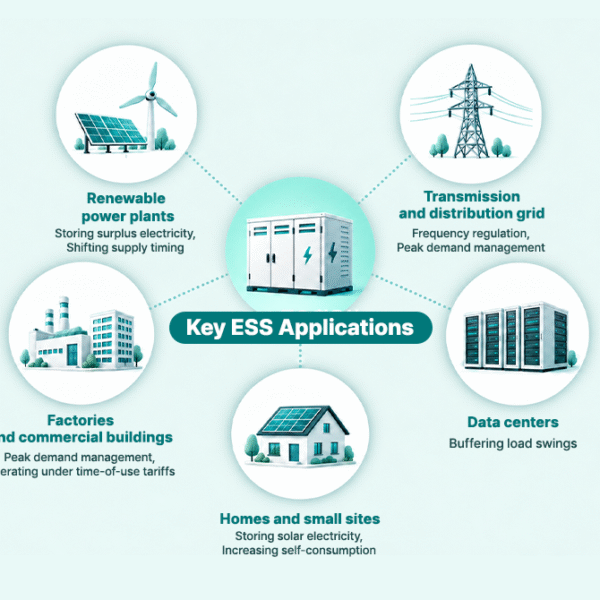
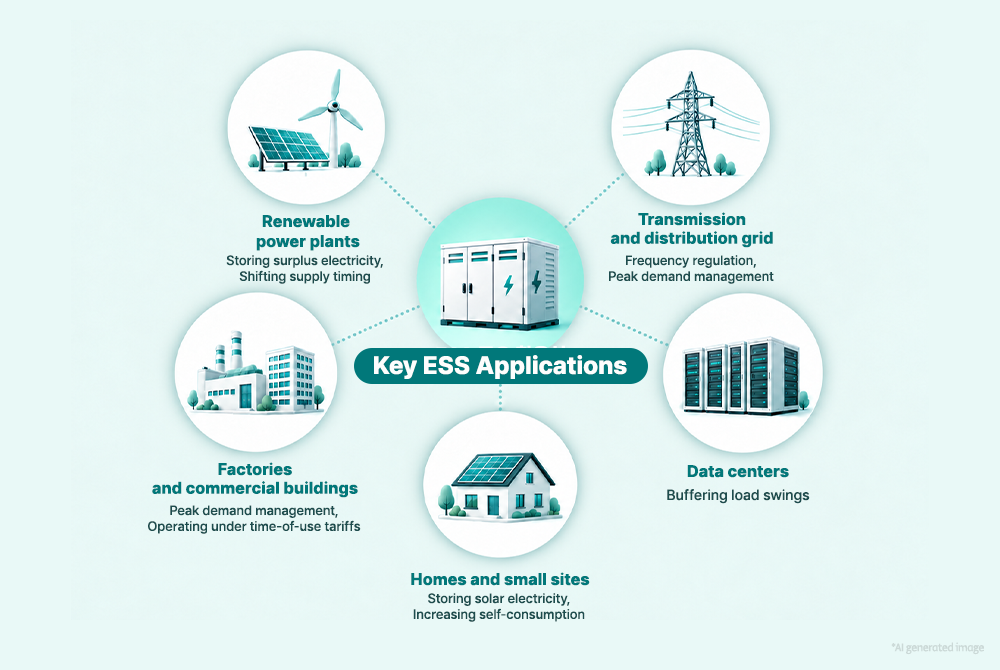
ESS is deployed across multiple stages of the power system — at renewable power plants, on transmission and distribution networks, at factories and commercial buildings, at data centers, and in homes — with storage capacity and operating patterns varying by location and purpose. As electrification advances and heating, transport, and industrial processes shift toward electricity, the range of places that need stored electricity widens as well.
| Application | Primary purpose | Example of operation |
|---|---|---|
| Renewable power plants | Reducing curtailment, shifting supply timing | Charging during the day when solar output is high, discharging in the evening |
| Transmission and distribution grid |
Frequency regulation, peak response, easing network constraints | Fast output adjustment for short fluctuations; sustained discharge during peaks |
| Factories and commercial buildings |
Peak demand management, operating under time-of-use tariffs | Charging during off-peak hours and discharging during high-use hours |
| Data centers | Buffering load swings, peak management, backup power | Operating within a designed scope alongside UPS** and power management systems |
| Homes and small sites |
Increasing solar self-consumption, outage preparedness | Using electricity stored during the day in the evening |
** UPS (Uninterruptible Power Supply): a device that supplies power from its internal battery for a limited time during an outage or voltage disturbance, protecting equipment such as computers and servers
ESS battery types and characteristics
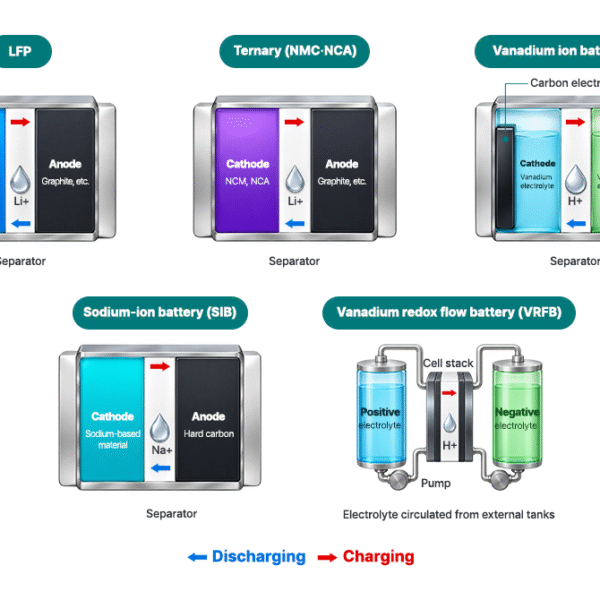
• How do LFP and ternary (NCM·NCA) batteries differ?
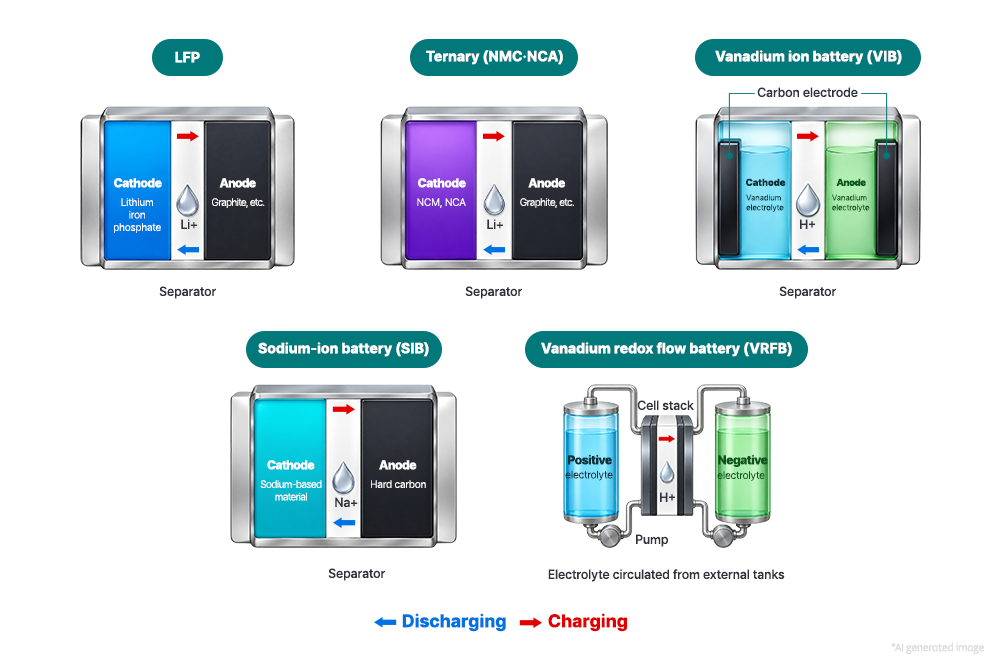
Lithium-ion batteries are the main chemistry used for ESS. The two best-known types are LFP (lithium iron phosphate) and ternary chemistries — NCM (nickel, manganese, cobalt) and NCA (nickel, cobalt, aluminum). Both work by moving lithium ions during charge and discharge, but their different cathode materials lead to differences in energy density, lifetime, and cost.
LFP has become the mainstream chemistry in today’s ESS market, thanks to its relatively high thermal stability, long charge-discharge life, and cost-effectiveness. In Global Energy Review 2026, the International Energy Agency (IEA) reported that “108 GW of new battery storage capacity was installed globally in 2025” — “a 40% increase on 2024, bringing installed capacity to 11 times the 2021 level” — and added that “LFP batteries account for around 90% of total installations.”
Ternary chemistries generally offer higher energy density, which is an advantage in applications such as electric vehicles where weight and volume are tightly constrained.
• What non-lithium ESS batteries are there? — Vanadium and sodium-based technologies
Lithium-ion is the mainstream chemistry for ESS, but technologies that do not use lithium are also being developed and demonstrated. A vanadium ion battery (VIB) uses a water-based electrolyte containing dissolved vanadium*** ions. Where a lithium-ion battery stores energy with lithium ions carrying the charge, in a vanadium ion battery hydrogen ions carry the charge while vanadium ions store the energy.
*** Vanadium: element 23 on the periodic table, a silvery-grey metal. Because a single element can exist in several oxidation states (multivalent ions), the same active material can be used at both the positive and negative electrodes.
A sodium-ion battery (SIB) uses sodium instead of lithium, which can reduce dependence on lithium resources. However, energy density, mass-production scale, and the materials supply chain remain challenges. Not using lithium does not automatically make every sodium-ion product cheaper than LFP or free from mineral supply-chain considerations; some compositions also use nickel, manganese, and other minerals.
Mainstream commercial technologies — lithium-based
| Type | Materials and structure | Strengths and considerations |
|---|---|---|
| Lithium iron phosphate (LFP) battery |
Lithium-ion battery using a lithium-iron-phosphate cathode | Strong on thermal stability, lifetime, and cost. Generally lower energy density than ternary chemistries |
| Ternary (NCM·NCA) battery |
NCM: nickel, manganese, cobalt NCA: nickel, cobalt, aluminum |
High energy density. Performance varies with composition and operating conditions; material costs are a consideration |
Non-lithium technologies
| Type | Materials and structure | Strengths and considerations |
|---|---|---|
| Vanadium ion battery (VIB) |
Sealed, integrated structure using a vanadium-based aqueous electrolyte | Output characteristics and fire safety are cited as strengths. Used in short-duration, high-output applications |
| Sodium-ion battery (SIB) | Sodium ions move during charge and discharge | Relatively good low-temperature performance. Energy density, mass production, and supply chain remain challenges |
| Vanadium redox flow battery (VRFB) |
Vanadium electrolyte circulated from external tanks through a cell stack (multiple cells layered together) | Power and capacity can be designed independently, which suits long-duration supply. Requires tanks, pumps, and management of a strongly acidic electrolyte |
Q1. What is the difference between an ESS and a battery?
A. A battery is the component that stores energy, while a BESS is a system that combines batteries with management (BMS), power conversion (PCS), operational control (EMS), and safety equipment. In its broader sense, ESS also covers non-battery methods such as pumped-storage hydropower.
Q2. What is the difference between a megawatt (MW) and a megawatt-hour (MWh)?
A. MW is power — the instantaneous rate — while MWh is a quantity of energy. Think of water from a tap: the force of the flow is MW, and the volume collected is MWh. A system rated at 1 MW with 4 MWh of usable stored energy can, in principle, supply electricity at 1 MW for about four hours (4 MWh ÷ 1 MW = 4 hours).
In practice, actual duration can be shorter depending on operating conditions such as state of charge, discharge rate, and temperature, as well as conversion losses.
Q3. How are short-duration and long-duration ESS distinguished?
A. They are distinguished by how long they can supply electricity and by their purpose. Short-duration storage addresses momentary fluctuations in power, while long-duration storage is used for sustained supply. The U.S. Department of Energy’s long-duration storage initiative, the Long Duration Storage Shot, targets grid storage capable of supplying electricity for 10 hours or more. The dividing line, however, varies by market and regulatory framework.
Q4. How do residential and industrial ESS differ?
A. They differ in storage volume, purpose, and installation environment. Residential systems are mainly used to store electricity from rooftop solar and to prepare for outages, while industrial systems are primarily aimed at supplying power during peak periods to manage costs. Capacity and form factor are chosen to match the required energy and available space, so not all systems are containerized. Using a system as backup power during an outage requires additional design features, such as the ability to operate islanded from the grid.
Q5. Are EV batteries and ESS batteries the same product?
A. They share the same underlying technology, but the required performance and system design differ. Safety is the top priority in both fields; beyond that, EVs prioritize energy density per unit weight and volume along with charging performance, while ESS places greater weight on cycle life under repeated operation.
Q6. Why do AI data centers need an ESS?
A. Power draw can swing sharply as AI computing jobs start and stop. An ESS responds to changes in power demand in real time to buffer load swings, and supplies stored electricity during hours of concentrated use to lower peak demand on the grid. Because adding new generation and transmission takes years, an ESS is drawing particular attention as a complement that can be built relatively quickly near the point of demand. That said, roles are typically divided among the ESS, UPS, backup generators, and load management.
📖 Glossary
| Term | Definition |
|---|---|
| ESS / BESS | Energy Storage System / an energy storage system that uses batteries as its storage medium |
| BMS / PCS / EMS | Battery Management System / Power Conversion System / Energy Management System |
| SOC / SOH | State of Charge / State of Health, an indicator of battery condition relative to its original performance |
| RTE | Round-Trip Efficiency. The ratio of energy recovered on discharge to energy put in on charge |
| DOD | Depth of Discharge. The share of reference capacity that has been discharged |
| Balance of plant | Supporting equipment other than the batteries and power conversion system — thermal management, fire detection and suppression, breakers, transformers, and switchboards |
| C-rate | The relative magnitude of charge or discharge current, measured against rated capacity |
| Cycle life | The number of charge-discharge cycles a battery can complete under specified conditions |
| Curtailment | Deliberately limiting generator output when supply exceeds demand or network capacity |
| Electrification | The shift of energy use in heating, transport, and industrial processes toward electricity |
■ Related articles

- [Energy’s Plot Twist] “Use More, Lose More?” With ESS, It’s the Opposite! The Structure and Advantages of LFP Batteries for ESS

- [Inside ESS] Powering the Future of Energy SK On ESS: GRIDON

- ESS: Powering the AI Era – SK On Sets a New Standard for ESS Safety

- [Energy 101] Watt vs. Watt-Hour: What Do W, Wh, kW, and kWh Mean?