When you need to charge your phone on the go, you reach for a portable battery. But did you know there are large-scale, industrial power banks that store electricity in advance and supply it whenever needed? They are called energy storage systems (ESS), and they play an increasingly important role in energy infrastructure.
As AI continues to expand, the number of data centers — facilities that consume enormous amounts of electricity — is rapidly increasing. Data centers are major consumers of electricity, projected to account for up to 12 percent of total electricity demand in the United States by 2028, up from just 1.9 percent in 2018. As power demand rises sharply, ESS is gaining attention as a key solution to ensure a stable and uninterrupted energy supply.
ESS can be implemented in various forms depending on how energy is stored. Representative examples include pumped hydro energy storage (PHES), compressed air energy storage (CAES), and battery-based systems like battery energy storage systems (BESS), which utilize batteries like lithium iron phosphate (LFP) batteries and vanadium-ion batteries (VIB).
As power demand from AI data centers continues to surge, BESS is emerging as a next-generation energy storage solution that offers fast response times and the flexibility to be deployed in a variety of environments, including those that are urban or space-constrained.
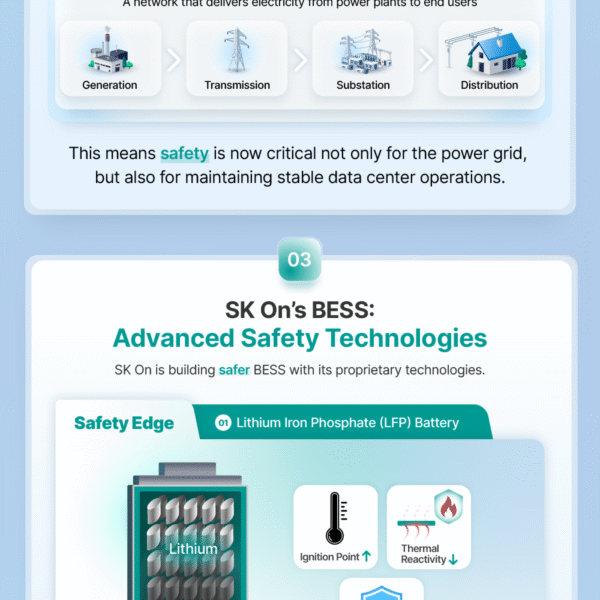
Take a closer look at the image below to explore how BESS is structured and operates, and see how SK On is addressing safety with its advanced technologies.

SK On is continuously advancing next-generation battery technologies, including VIB, to enhance the safety and reliability of BESS. As the energy landscape evolves, SK On remains committed to delivering safer and more sustainable ESS solutions — pushing the future of energy infrastructure forward.
■ Related articles

- [Expert Lens] How Energy Security Presents a New Opportunity for the Korean Battery Industry

- [Expert Lens] The Case for Ternary Batteries in Emerging Industries

- [Battery Deep Dive] Part 5: Seven-Minute Fast Charging

- [Battery Deep Dive] Part 6: On-vent Prismatic Cell

- [Battery Deep Dive] Part 7: Pouch-Integrated Prismatic Cell