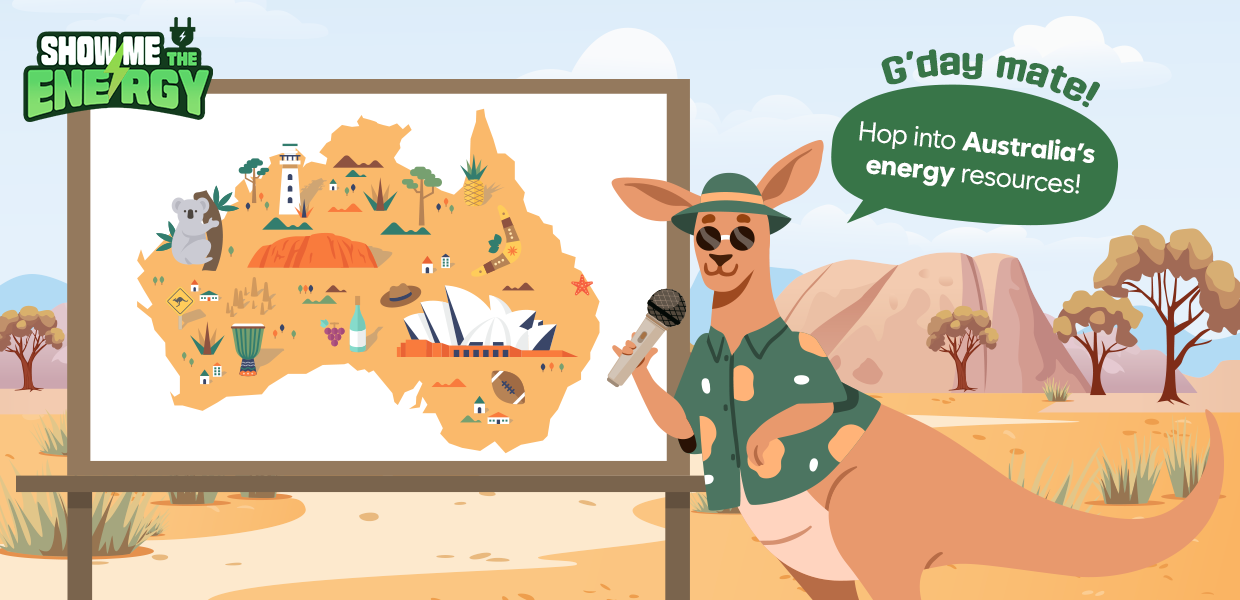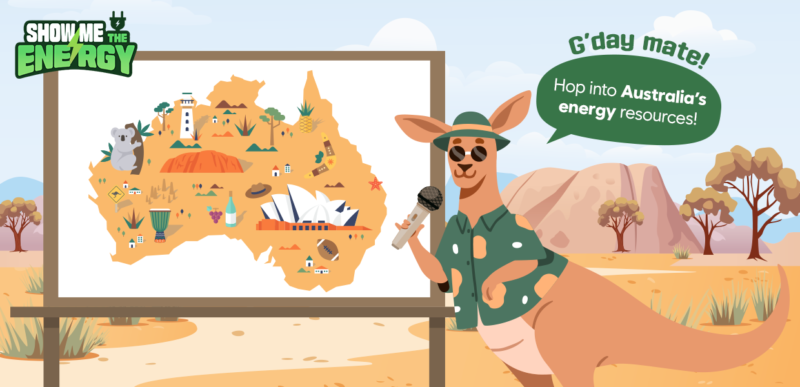
G’day, mate! I’ll be your guide for today’s tour—a dapper kangaroo proudly representing Australia!
When you think of Australia, what comes to mind? Probably a kangaroo like me, our vast open landscape (we’re the sixth-largest country in the world!), breathtaking natural beauty, the iconic Sydney Opera House, and ancient Indigenous cultures that stretch back tens of thousands of years. But let me tell ya, there’s so much more to this incredible land than meets the eye.
Officially known as the Commonwealth of Australia, this expansive nation covers an impressive 7.69 million square kilometers.¹ Once renowned as a “resource-rich nation” with abundant coal and oil reserves, Australia is now making waves globally as a leader in renewable energy, while also supplying critical materials for the world’s cutting-edge industries.
With its vast terrain and rich natural resources, Australia has built strong global competitiveness in both traditional and renewable energy. Ready to explore? Let’s hop in!
From Coal to LNG: Fossil Fuel Power!
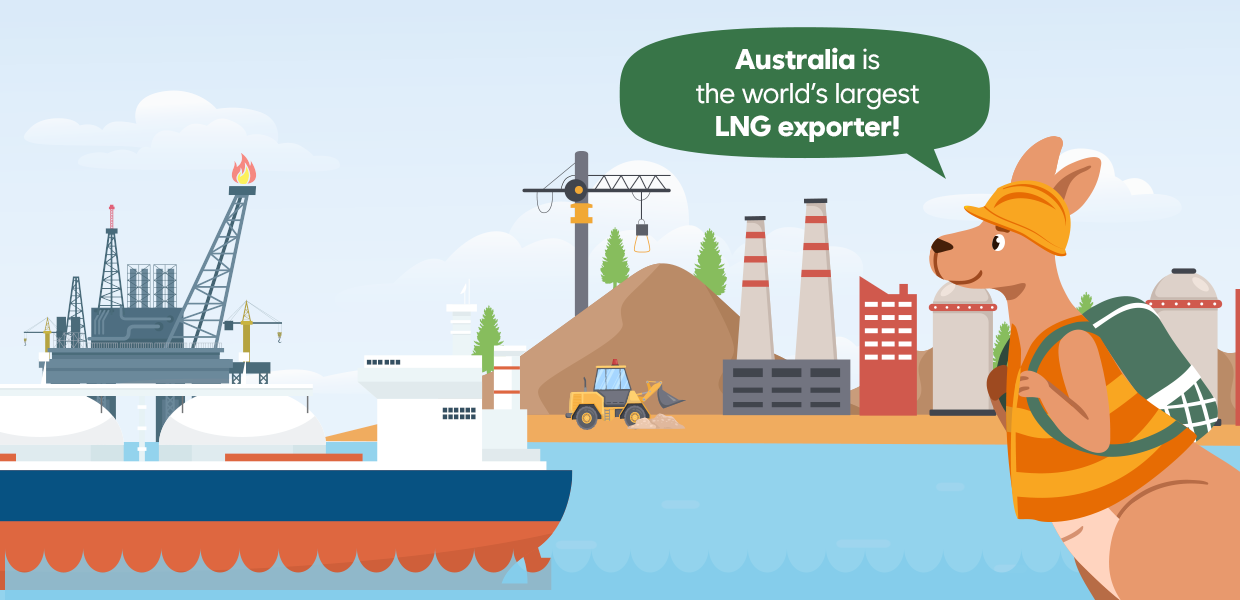
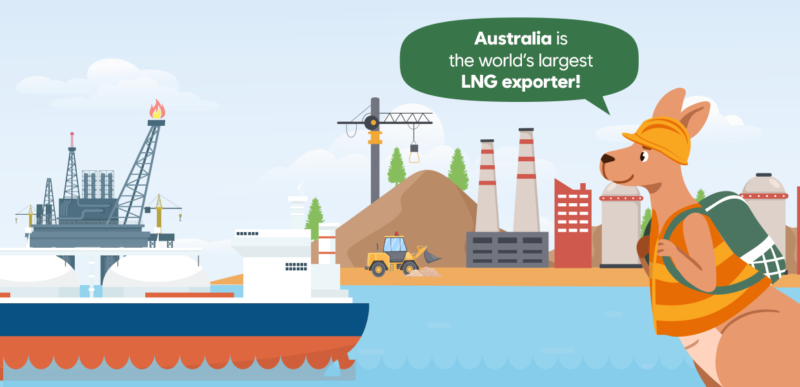
Australia is a global leader in fossil fuels, boasting abundant reserves of coal, oil, and natural gas. Between 2022 and 2023, the country’s primary energy* production reached approximately 18,710 petajoules (PJ)**—with coal making up about 60% and natural gas around 33%2. Additionally, Australia ranked as the world’s seventh-largest producer of natural gas in 2022, producing around 120 million tons3. Natural ga exports, particularly in the form of Liquefied Natural Gas (LNG), have grown significantly since 2015. In 2022 alone, Australia exported approximately 84 million tons of LNG, and it remains the world’s largest LNG exporter to date4.
(*) Primary energy: Energy sources obtained directly from nature without processing, such as oil, coal, natural gas, hydro, nuclear, and renewables.
(**)Petajoule (PJ): A unit of energy equal to 1 quadrillion (10¹⁵) joules. For reference, 1 PJ is equivalent to roughly 278 gigawatt-hours (GWh)
South Korea and Australia: A Strong Energy Partnership
Australia primarily exports LNG to countries across the Asia-Pacific region, with South Korea accounting for approximately 15% of its total LNG exports. In return, South Korea exports petroleum products such as diesel and gasoline to Australia, which has remained Korea’s largest export market for petroleum products for three consecutive years5. This mutually beneficial energy trade underscores the strong economic ties between the two nations, with energy serving as a key pillar of their ongoing cooperation.
Australia: A Treasure Trove of Minerals!
Australia’s mineral wealth is as vast as its land. The country holds the world’s largest reserves of iron ore and uranium, ranks second in copper reserves, and is the third-largest producer of gold6.
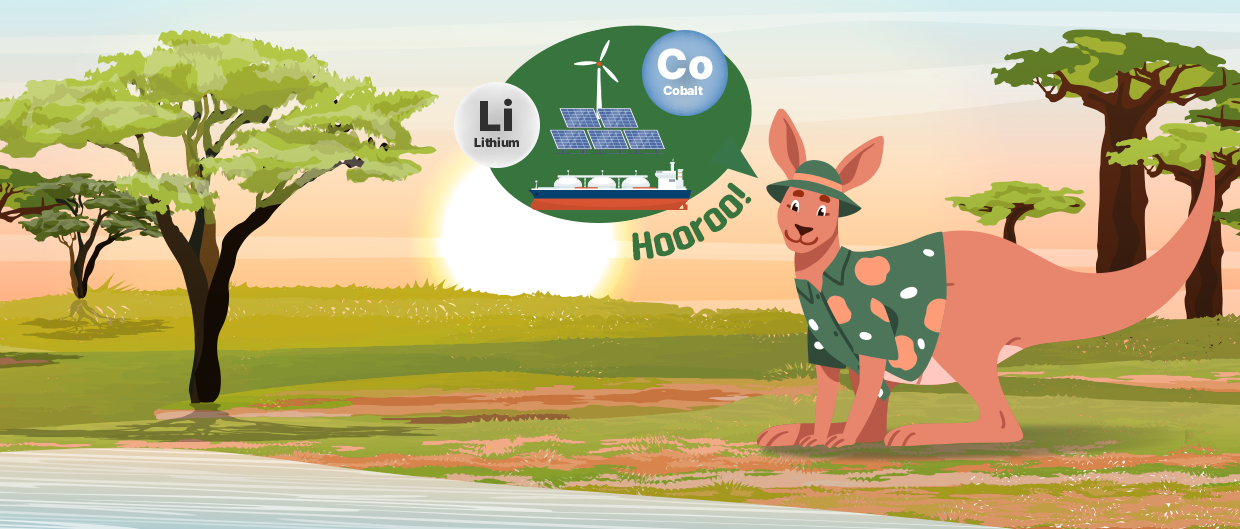
Beyond these major resources, Australia is also a key supplier of critical minerals essential to high-tech industries, including lithium, nickel, cobalt, and rare earth elements. Let’s take a closer look at some of the key minerals that make Australia shine.
Lithium – The “White Oil”
Lithium is a key raw material used in smartphones, laptops, and electric vehicle (EV) batteries—so essential that it has earned the nickname “white oil.” While Australia holds the world’s second-largest lithium reserves (22.4%), it was the world’s leading producer in 2023, with an output of approximately 86,000 tons7. Most of this lithium comes from Western Australia’s Greenbushes and Pilbara mines.
South Korean Companies Strengthen Lithium Supply Chains with Australia
Recently, South Korean companies have been actively working to strengthen lithium supply chains sourced from Australia. For example, SK On signed a long-term agreement with POSCO Pilbara Lithium Solution to secure up to 15,000 tons of lithium hydroxide from the Pilbara mine over a three-year period starting in 2025.
Rare Earth Elements – The “Vitamins” of High-Tech Industries
Rare earth elements are crucial for advanced technologies like semiconductors, displays, EV motors, and wind turbines. Despite their name, rare earths are relatively abundant in nature, but they occur in low concentrations, making extraction challenging. According to the International Energy Agency (IEA) and the United States Geological Survey (USGS), Australia ranks sixth in rare earth reserves and fourth in global production, with approximately 18,000 tons produced in 20238. Rare earths mined in Western Australia are particularly prized for their high quality, drawing significant global attention.
Cobalt – A Key Material for EV Batteries
Cobalt is a core material for EV batteries, specifically in cathodes, where it enhances both safety and performance. Australia holds the world’s second-largest cobalt reserves—about 1.7 million tons—and ranked fourth in global production in 2023, with an estimated output of 4,600 tons9. As the global EV battery market continues to grow, Australia’s abundant cobalt resources are drawing increased attention.
A Rising Star in Renewable Energy
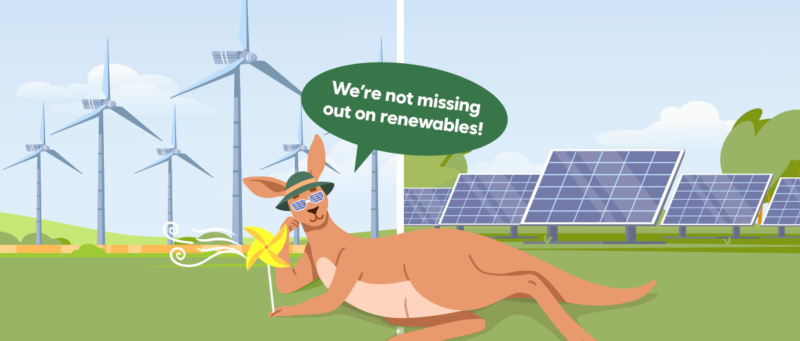
Australia is moving beyond its image as a fossil fuel giant and emerging as a strong player in the renewable energy sector. In 2023 alone, the country added over 5 gigawatts (GW) of renewable power capacity10. With abundant natural resources like sunlight, wind, and water, Australia is paving the way toward a more sustainable energy future.
Wind Power – Leading the Renewable Revolution
Wind energy is Australia’s top source of renewable power generation. As of 2021, it accounted for approximately 35.9% of the country’s total renewable electricity output—the largest share among renewable sources. With vast open plains and strong, consistent winds, wind power has become a key pillar of Australia’s energy portfolio.
Solar Power – A Shining Leader with the World’s Highest Adoption Rate
Thanks to its sunny skies and abundant sunlight, Australia has emerged as a global powerhouse in solar energy. As of September 2024, approximately 3.92 million solar panel systems were in operation across the country—one of the highest adoption rates in the world11. Solar energy is widely utilized not only in residential areas but also across industries and public facilities, cementing Australia’s role as a leader in the global solar energy market.
CCS – Innovation Driving Carbon Neutrality
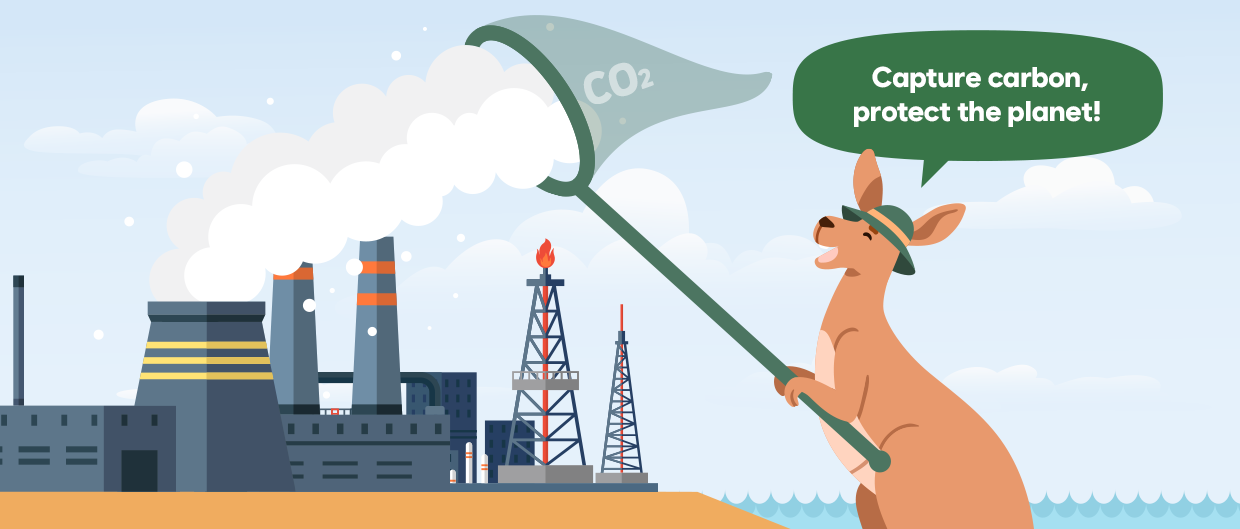
As the world races toward net-zero emissions, Australia is stepping up as a leader in Carbon Capture and Storage (CCS) technologies. CCS captures and stores carbon dioxide emissions, making it an important tool for reducing greenhouse gases and combating climate change.
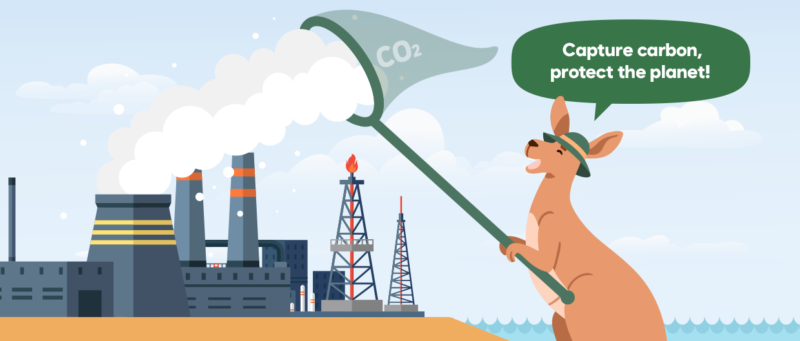
Did you know that Australia is expanding its large-scale CCS projects? The government has set a goal to achieve carbon neutrality by 2050 and is actively investing in international partnerships. One example is a AUD 50 million collaboration with South Korea over the next decade to support the development of carbon-neutral technologies.
SK’s Carbon Neutrality Efforts: Global CCS Projects with Australia
SK Innovation E&S is planning to produce approximately 1.3 million tons of LNG annually from the Barossa gas field in Australia, starting in the second half of 2025. This LNG is set to be used in South Korea’s blue hydrogen production process, with the carbon dioxide (CO₂) generated during production permanently stored in overseas CCS facilities using advanced capture and storage technologies.
Additionally, SK Earthon has acquired joint exploration rights in the Carnarvon Basin, located off the northern coast of Australia, and is currently assessing its feasibility for CO₂ storage. If the site is deemed viable, large-scale carbon injection operations are expected to begin by 2030, enabling SK to secure a major offshore CO₂ storage site through this initiative.
CCS is a key technology for tackling climate change and promoting a sustainable energy industry. Through the development of cutting-edge CCS technologies and the expansion of large-scale projects, Australia is gearing up for a significant transformation—from an energy powerhouse to a global leader in renewable energy.
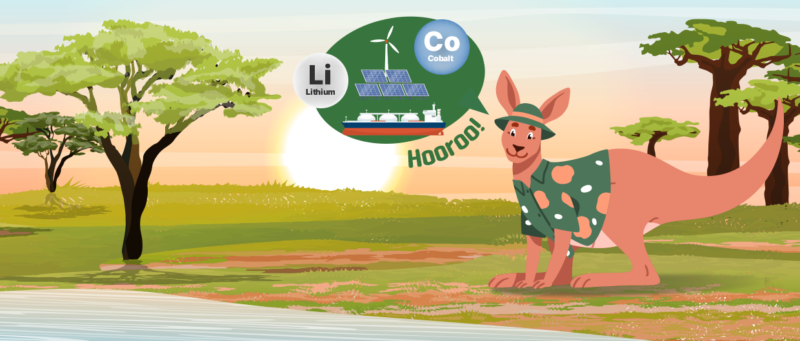
How was your energy tour of Australia with me? Today, we explored Australia’s abundant resources and its efforts to transition toward sustainable energy future. Let’s look forward to the bright future the Australian energy industry is set to create!
Well then, it’s time for me to hop back across this big ol’ Aussie land (boing)! Hooroo!
[References]
1 Ministry of Foreign Affairs
2 Australian Government, Clean Energy Regulator. Energy Production.
3 Korea Energy Economics Institute, World Energy Market Insight [Issue Paper 13-14]
4 Korea Energy Economics Institute, World Energy Market Insight [Issue Paper 15]
5 Korea Energy Economics Institute, World Energy Market Insight [Issue Paper 16]
6 Office of the chief economist. Australian Government, Department of Industry, Science and Resources. (2024), Resources and Energy Quarterly December 2024.
7 U.S. Geological Survey, 2024, Mineral commodity summaries 2024: U.S. Geological Survey, 212p., https://doi.org/10.3133/mcs2024. p. 111
8 U.S. Geological Survey, 2024, Mineral commodity summaries 2024: U.S. Geological Survey, 212p., https://doi.org/10.3133/mcs2024. p. 145
9 U.S. Geological Survey, 2024, Mineral commodity summaries 2024: U.S. Geological Survey, 212p., https://doi.org/10.3133/mcs2024. p. 63
10 Australian Government, Clean Energy Regulator, (2023), Quarterly Carbon Market Report December Quarter 2023.
11 Australian PV Institute (APVI) Solar Map, funded by the Australian Renewable Energy Agency, accessed from pv-map.apvi.org.au on 20 March 2025. Clean Energy Council.
– SK Earthon secures carbon storage exploration rights in Australia, boosting resource development and clean energy
– SK Earthon cooperates with Azuli to identify and develop CCS enabled solutions globally
– SK On inks lithium supply deal with Australia’s Lake Resources
– SK E&S and the Australian Government Solidifies Joint Collaboration for Green Energy Business
– SK E&S Writes New History in Resource Development, Opens low-carbon Liquefied Natural Gas (LNG) Era