Some things are not quite what their names suggest. Peanut butter has no butter in it. Dry ice is not actually ice.
And the energy world has its own version of this surprising mismatch. It is an oil, but it does not come from an oil field. It comes from a gas field.
Meet condensate, the star of today’s story.
| You Produce Gas, but Get Oil Too?
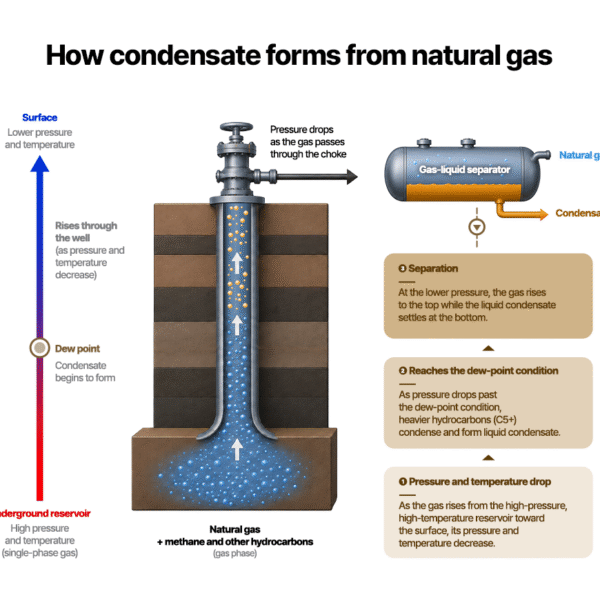
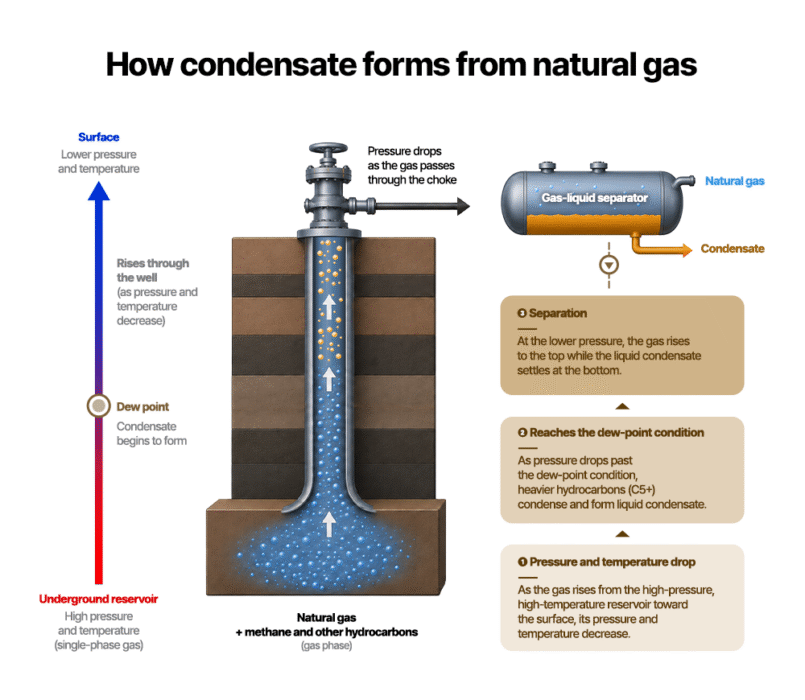
Our story begins deep underground. Far beneath the surface, natural gas sits trapped under intense pressure and heat, as a mixture of methane and various other hydrocarbons. But what happens when that gas starts making its way to the surface?
As it rises, the pressure and temperature fall. When that happens, some of the heavier hydrocarbons mixed in with the natural gas can condense into liquid. The liquid hydrocarbons separated and recovered during natural gas production are known as **condensate**.
Despite being an “oil,” condensate looks very different from the dark, thick crude oil most of us picture. It is much lighter, clearer, and often has a pale golden hue.
| It’s Not Just “Lighter Crude”
So, is condensate simply a lighter form of crude oil? Not quite. This is where its real plot twist comes in.
Conventional crude oil, the dark and viscous kind most people are familiar with, contains a wide range of heavy components. To turn those components into lighter products such as gasoline and naphtha, refineries need to put the crude through multiple complex processing steps. Condensate, on the other hand, is naturally rich in lighter components, particularly naphtha. That means it can be turned into refining and petrochemical feedstocks without the extensive processing needed to break down heavier components.
And naphtha is where condensate really earns its keep. Naphtha is used not only to make petroleum products such as gasoline, but also as a key petrochemical feedstock for producing ethylene and paraxylene (PX), which ultimately go into plastics, synthetic fibers, and countless everyday products. In other words, condensate’s high naphtha content gives it a two-in-one advantage: it can help produce both fuels and the building blocks of everyday materials.
👀 Conventional Crude Oil vs. Condensate at a Glance
| Category | Conventional Crude Oil | Condensate |
| Production | Oil fields | Gas fields |
| Appearance | Dark and viscous | Clear and light |
| Composition | A broad mix of light and heavy hydrocarbons | Rich in lighter components such as naphtha |
| Processing | Requires multiple refining steps | Relatively simpler to process |
| Main uses | Gasoline, diesel, fuel oil, asphalt, and more | Naphtha → gasoline, jet fuel, and petrochemicals (e.g., PX) |
| From an Australian Gas Field to a Korean Refinery
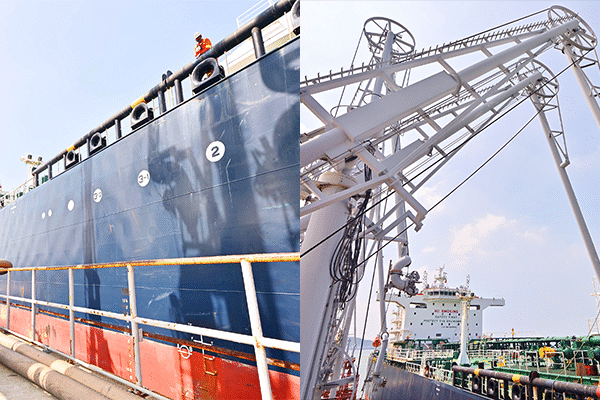
And this is not just something happening far away. Condensate from an overseas gas field has recently made its way to a refinery in Korea. In August 2026, SK Innovation E&S brought approximately 300,000 barrels of condensate produced at Australia’s Barossa gas field into the Port of Incheon. It was the first time a Korean private-sector company had directly imported condensate secured through an overseas resource development project of its own.
SK Innovation E&S has been involved in the Barossa project since 2012 and is expected to secure approximately 1.1 million barrels of condensate and 1.3 million tonnes of LNG from the gas field each year. In other words, resources from a single gas field will make their way to Korea in two different forms, LNG and condensate, each playing its own role in the country’s energy industry. There is another important benefit as well. For Korea, which has long relied heavily on the Middle East for crude oil imports, condensate from Australia provides another source of supply, helping diversify imports and strengthen supply stability.
This shipment of condensate will be processed at SK Incheon Petrochem’s facilities. The naphtha produced from it will then be used as a feedstock for paraxylene as well as petroleum and petrochemical products such as gasoline and jet fuel. A resource produced at a gas field far off the coast of Australia crosses the Pacific, arrives in Korea, and is processed directly at domestic refining and petrochemical facilities, where it is transformed into valuable feedstocks.

| Condensate: Somewhere Between Gas and Oil
So, is condensate a gas or an oil?
The answer is not quite so simple. It is produced alongside natural gas in a gas field, but as it reaches the surface and conditions change, it becomes a liquid that can be transported and processed much like oil.
You set out to produce gas, and oil comes along with it. From that oil, you can make gasoline and jet fuel, as well as raw materials that eventually become plastics and clothing. And now, this unexpected energy plot twist has crossed the Pacific and arrived in Korea.
Energy has a way of surprising us. See you in the next story of Energy’s Plot Twist.
■ Related articles

- [Energy’s Plot Twist] Why Get Heated? Turning Waste Heat Back Into Energy

- SK Innovation E&S to Bring Home Condensate from Australia After LNG