💡 Key Takeaways
- LNG is natural gas cooled to about −162°C, turning it into a liquid that takes up far less space. It is transported on LNG carriers, then turned back into gas for use as fuel in power generation, industry, and homes.
- In an LNG combined-cycle power plant, a gas turbine generates electricity first. Heat from its exhaust then makes steam to generate more electricity. This produces more electricity from the same amount of fuel, while allowing the plant to adjust its output as demand changes.
- LNG can also fuel combined heat and power plants, which supply both electricity and heat for space heating.
- LNG power generation is being considered for AI data centers because it can supply firm power at the scale and times required. LNG reaches power plants and city gas networks through a value chain covering production, liquefaction, transport, storage, regasification, and supply.
What is LNG?
LNG (liquefied natural gas) is natural gas cooled to about −162°C (−260°F) to turn it into a liquid. The natural gas comes from underground gas fields and other sources, and consists mainly of methane. In liquid form, it takes up about 1/600 of its volume as a gas, allowing large quantities to be transported and stored at once.
To supply natural gas across oceans where pipelines are impractical, it is liquefied and carried on LNG carriers. Insulated tanks aboard the ships and on land limit the entry of outside heat and help maintain the low temperature. When the LNG arrives, heat is added to turn it back into gas. This process is called “regasification.”
The natural gas then travels by pipeline to power plants, factories, and city gas networks, the piped systems that distribute natural gas to end users. Power plants use it to generate electricity, while factories use it to produce heat for manufacturing. In homes, it is supplied as city gas for cooking, heating, and hot water.
How does LNG generate electricity?
LNG power plants generate electricity by using natural gas obtained through regasification as fuel. In Korea, “LNG power generation” generally refers to this type of natural gas-fired generation.
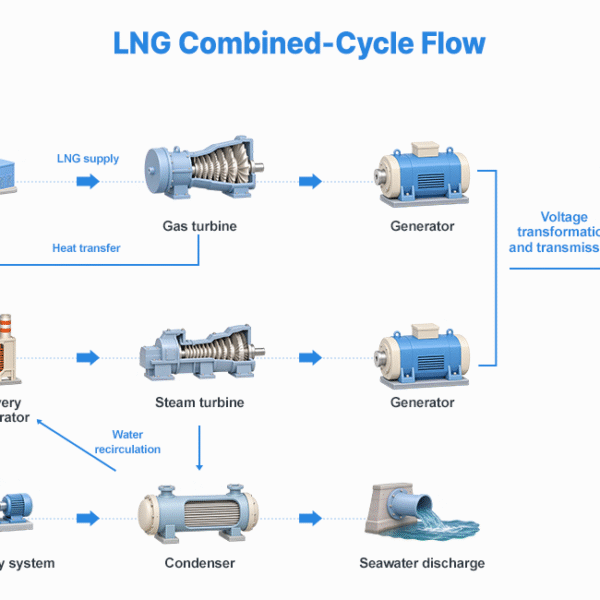
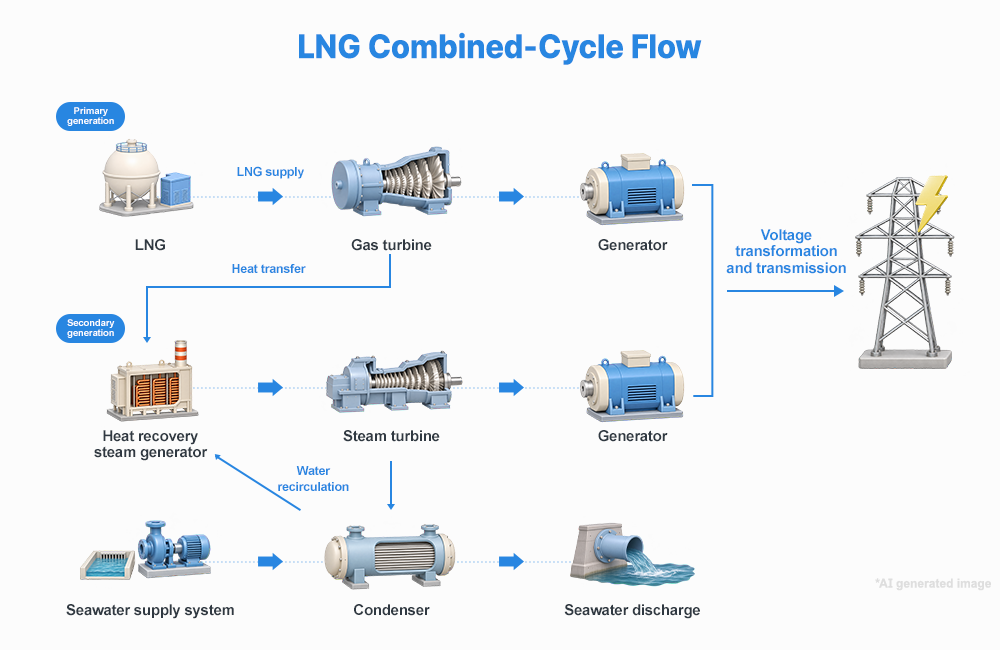
Combined-cycle power generation is a common way to use LNG to generate electricity. “Combined-cycle” means using both a gas turbine and a steam turbine to generate power. It puts the energy released by burning the fuel to use in two stages.
Stage 1: Generate electricity with a gas turbine
Natural gas is mixed with compressed air and burned to produce hot gas. That gas spins the gas turbine connected to a generator, which produces electricity.
Stage 2: Use exhaust heat to generate more electricity
The exhaust leaving the gas turbine still contains considerable heat. A heat recovery steam generator (HRSG) captures that heat and uses it to turn water into steam. The steam drives a steam turbine to generate more electricity. Plants may arrange their generators differently, but they all put the exhaust heat to use for a second round of generation.
Compared with a gas turbine operating on its own, a combined-cycle plant loses less energy as waste heat and produces more electricity from the same amount of fuel.
| Generation method | How it produces electricity | How it uses heat |
|---|---|---|
| Simple-cycle gas turbine | Hot gas from burning fuel drives a gas turbine | The gas turbine’s exhaust heat is not used to generate electricity in a separate steam turbine |
| Boiler and steam turbine | Fuel heats water in a boiler, producing steam that drives a steam turbine | Steam produced in the boiler is central to the generation process |
| Combined-cycle power generation | A gas turbine generates electricity first; its exhaust heat then produces steam for additional generation | Combining gas and steam turbines makes more efficient use of the fuel |
The difference between combined-cycle generation and conventional thermal power generation
Combined-cycle generation is also a form of thermal power generation: it burns fuel to produce electricity. A conventional coal-fired plant boils water to make steam that drives a turbine. An LNG combined-cycle plant runs a gas turbine first, then uses its exhaust heat to make steam and run a second turbine.
Why can LNG power plants start up quickly?
Because hot gas from burning fuel drives the turbine directly, a gas turbine can start generating electricity sooner than a system that first has to make steam in a large boiler. It can also adjust its output during operation to respond to changes in electricity demand.
To start the plant, a starting system turns the gas turbine shaft, and a compressor compresses air. Natural gas is mixed with the air and ignited. The resulting hot gas speeds up the turbine, and the generator begins supplying electricity once it is connected to the grid. In a combined-cycle plant with separate generators for the gas and steam turbines, the gas turbine can produce electricity while the steam for the second stage is still being prepared.
As the share of solar and wind power, whose output varies over time, grows on the grid, the ability to start generation when needed and adjust output becomes increasingly valuable.
LNG power generation and renewable energy
LNG power plants can adjust their output to help balance changes in supply from solar and wind power. This makes them a “flexible, dispatchable power source” that can support renewable energy. For example, when solar output falls as the sun sets, other generators must increase their output or stored electricity must be used.
In practice, grids use several measures alongside LNG generation, including battery storage and demand response.
Why is LNG power generation being considered for AI data centers?
LNG power generation can supply firm power on a planned schedule, make efficient use of fuel by capturing exhaust heat, and draw on established equipment and existing infrastructure. These are among the reasons it is being considered as a power source for AI data centers.
1. Supplying the required amount of power when needed
LNG power plants can produce the required amount of electricity at planned times, making them a potential power source for AI data centers that use large amounts of electricity continuously. Their AI servers and cooling equipment run for long periods, so they need a steady supply of power.
2. Improving fuel efficiency by using exhaust heat
LNG combined-cycle plants use exhaust heat to produce more electricity from the same amount of fuel. For a plant supplying a data center with high electricity demand, this efficiency can help manage fuel use and operating costs.
3. Using established technology and existing facilities
Another reason LNG power is being considered is that it can use proven gas turbine technology and existing energy facilities. In the Base Case of its 2025 report Energy and AI, the International Energy Agency (IEA) projects that natural gas will make the largest contribution to meeting the increase in electricity demand from U.S. data centers through 2030. In areas that already have power plants, LNG supply facilities, and grid connections, that infrastructure can be used to supply electricity.
Data centers also use UPS* and energy storage systems alongside these power sources to prepare for brief outages or other power disturbances.
* UPS (Uninterruptible Power Supply): A device that supplies electricity for a limited time during an outage or other power disturbance, helping maintain power while the supply switches to another source.
How are electricity and heat from LNG used together?
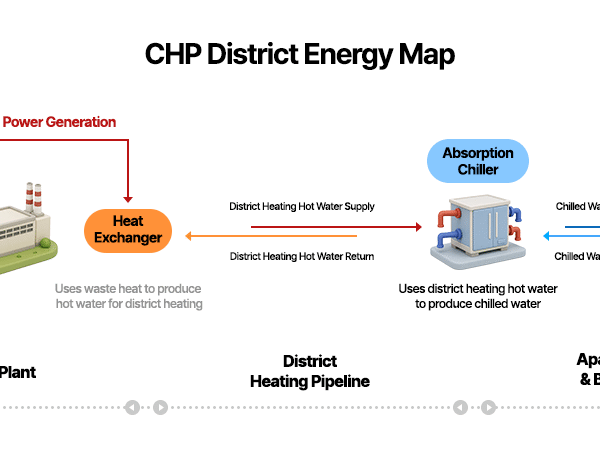
LNG is used to generate electricity and to provide heat for buildings and industry. An LNG-fueled combined heat and power plant captures heat produced during electricity generation and supplies it as hot water for heating or steam for industrial use. Producing both electricity and usable heat from a single fuel is known as combined heat and power (CHP).
District energy and district heating
District energy is a system that supplies heat, or both heat and electricity, from a central facility such as a CHP plant to multiple users. District heating is a common form of district energy that supplies heat for space heating and hot water to homes and other buildings. The heat travels to buildings through pipes, where heat exchangers transfer it to the heating and hot water systems.
| Term | What does it describe? | How does it relate to the others? |
|---|---|---|
| Combined heat and power | A method of producing electricity and usable heat together | A CHP plant can supply heat to a district energy system |
| District energy | A system that supplies heat, or both heat and electricity, from a central facility to multiple users | Includes district heating and cooling, as well as heat supply to industrial complexes |
| District heating | A system that supplies heat for space heating and hot water to multiple homes and buildings | A common form of district energy |
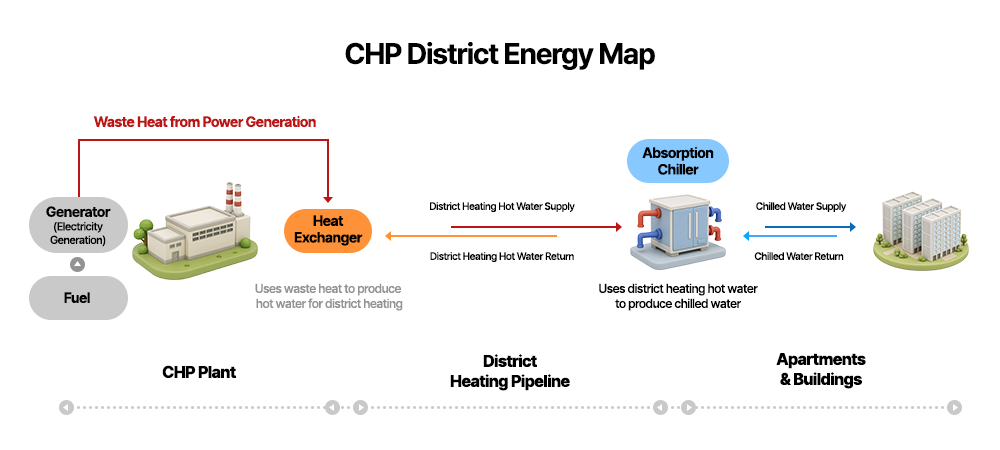
Combined-cycle generation refers to the use of both gas and steam turbines to generate electricity. CHP focuses on producing electricity alongside heat that can be used outside the plant. A combined-cycle plant can also operate as a CHP plant if it is equipped to supply heat.
How does LNG reach users? Inside the LNG value chain
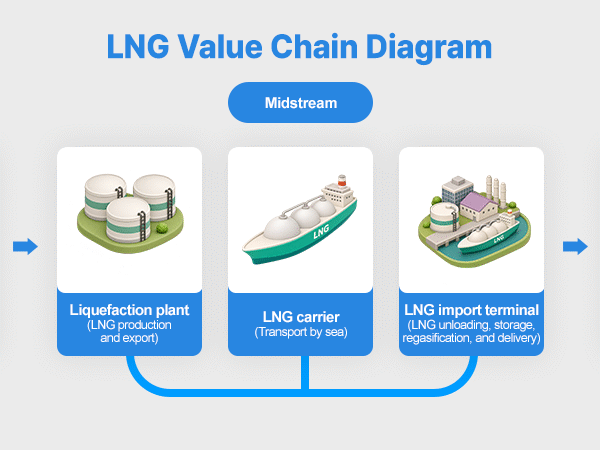
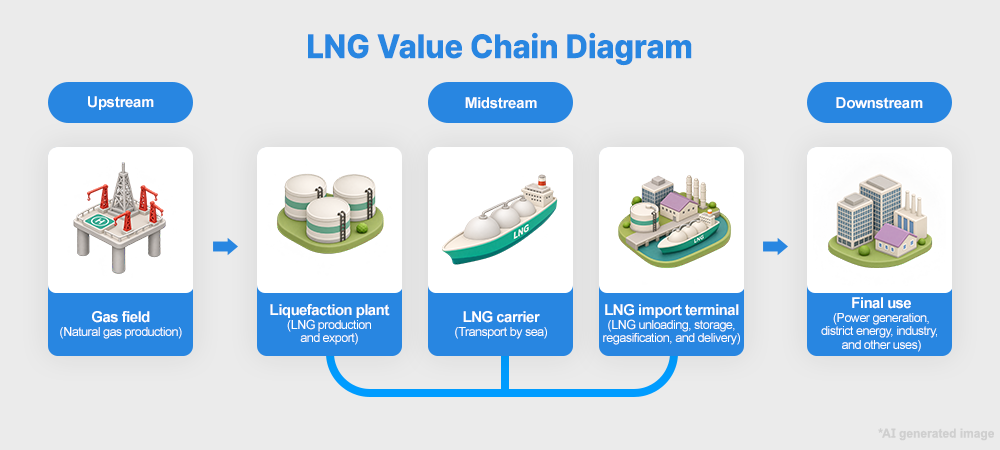
LNG passes through natural gas production, gas processing (treatment) and liquefaction, transport by ship, storage and regasification at a terminal, and delivery to its final users. This series of activities, from the gas field to the point of use, is called the LNG value chain**. Natural gas production at the gas field is the upstream stage. Liquefaction, shipping, terminal storage, and regasification make up the midstream stage, while final uses such as power generation, district energy, and industrial processes are downstream.
** Value chain: The full sequence through which a product or service is made and delivered, from sourcing raw materials to processing, transport, storage, and supply
The role of an LNG terminal
An LNG import terminal stores LNG brought in from overseas and serves as a hub for supplying it within the country. At the terminal, LNG is unloaded from carriers, stored in tanks, turned back into gas, and sent into pipelines. The terminal connects LNG shipped from overseas with domestic power plants and gas supply networks.
How SK Innovation E&S has built an LNG value chain
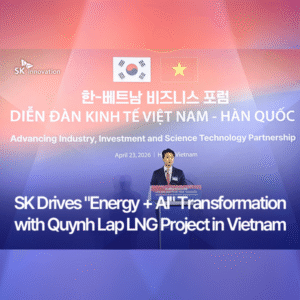
SK Innovation E&S has developed an LNG value chain extending from overseas gas fields to power generation in Korea. Natural gas from Australia’s Barossa gas field, a project in which the company participates, travels through an undersea pipeline to the Darwin LNG terminal, where it is liquefied. The first carrier transporting this LNG arrived at the Boryeong LNG terminal in Chungcheongnam-do in February 2026. Once turned back into gas at Boryeong, it is used as fuel at power plants in Korea. The company is also applying its experience in building LNG value chains to overseas power projects, including the Quynh Lap LNG project in Vietnam.
★ Frequently asked questions about LNG
Q1. Are LNG and natural gas the same thing?
A. LNG is natural gas that has been turned into a liquid for transport and storage. Cooling natural gas to about −162°C reduces its volume to about 1/600 of its volume as a gas. At an import terminal, LNG delivered by carrier is turned back into gas and supplied to power plants, factories, and city gas networks.
Q2. Are LNG and LPG the same gas?
A. No. They have different main components and are stored as liquids in different ways. LNG is natural gas, made up mainly of methane, that has been cooled to a very low temperature. LPG (liquefied petroleum gas) consists mainly of propane and butane and is usually stored as a liquid under pressure.
Q3. Do “LNG power plant” and “combined-cycle power plant” mean the same thing?
A. No. The terms describe different aspects of a power plant. “LNG power plant” identifies the fuel it uses, while “combined-cycle power plant” describes how it generates electricity. A plant that uses LNG as fuel and has both gas and steam turbines is an LNG combined-cycle power plant.
Q4. What is the difference between combined-cycle generation and CHP?
A. Combined-cycle describes how electricity is generated, while CHP describes the production of heat for use outside the plant alongside electricity. A combined-cycle plant generates electricity with a gas turbine, then uses its exhaust heat to produce steam and generate more electricity with a steam turbine. A CHP plant produces electricity as well as heat for heating or industrial use. Both approaches can be used in the same plant if a combined-cycle facility is designed to supply heat.
Q5. How efficient is LNG combined-cycle power generation?
A. An LNG combined-cycle plant uses heat from a gas turbine’s exhaust to run a steam turbine, producing more electricity from the same amount of fuel. In Exhibit 4-4 of the U.S. National Energy Technology Laboratory’s 2025 report Cost and Performance Baseline for Fossil Energy Plants, Volume 1: Bituminous Coal and Natural Gas to Electricity, two large natural gas combined-cycle configurations (Case B31A·B31B) have net plant efficiencies of 60.5% and 63.6% on a lower heating value (LHV) basis. In other words, about 60 to 64 of every 100 units of energy in the fuel, measured on an LHV basis, can be converted into electricity. Efficiencies calculated on a higher heating value (HHV) basis are lower, and actual efficiency varies with the equipment and operating conditions.
Q6. If LNG prices rise, will electricity rates go up immediately?
A. Not immediately. LNG costs feed into the cost of generating electricity, but they reach retail rates with a lag, and the size of the effect depends on import contract terms, exchange rates, and how rates are regulated in each market. Much of the world’s LNG is bought under term contracts indexed to oil or gas hub prices rather than at spot prices, so a move in a headline spot price does not translate directly into what a utility pays. In Korea, for example, KEPCO sets a quarterly fuel cost adjustment rate from the average import prices of bituminous coal, LNG, and heavy fuel oil over an earlier three-month period, subject to a cap — so a price change appears in bills only after a delay. (KEPCO, Q4 2026 fuel cost adjustment rate— in Korean)
Q7. Does hydrogen co-firing mean burning only hydrogen?
A. No. Hydrogen co-firing burns hydrogen together with natural gas. Using hydrogen as the sole fuel is called “100% hydrogen firing.” The proportion of hydrogen that can be blended depends on the gas turbine and other equipment, so the system and operating conditions must be suited to the intended blend.
Q8. How do companies import LNG directly for their own use?
A. Direct LNG import refers to a power company or industrial user importing natural gas from overseas for its own power generation or production needs. The imported LNG is stored at a terminal, turned back into gas, and supplied to a power plant or industrial facility. Article 2 (9) of Korea’s City Gas Business Act defines a “direct importer for own use” as a person who directly imports natural gas to consume it for purposes prescribed by Presidential Decree, including power generation and industrial use.
📖 Glossary
| Term | Definition |
|---|---|
| Liquefied natural gas (LNG) |
Natural gas turned into a liquid for transport and storage |
| Gas turbine / Steam turbine | Devices spun by the flow of hot gas and steam, respectively. They are connected to generators to produce electricity |
| Heat Recovery Steam Generator (HRSG) |
A device that captures heat from a gas turbine’s exhaust and uses it to produce steam |
| Combined Heat and Power (CHP) |
A method of producing both electricity and usable heat from a single energy source |
| LNG terminal | An import facility where LNG is unloaded, stored, turned back into gas, and sent into pipelines |
| Regasification | The process of adding heat to liquid LNG to turn it back into natural gas |
| Flexible power source | A power plant that can adjust its output in response to changes in electricity demand and output from other sources |
| Upstream / Midstream / Downstream | Gas production / Liquefaction, transport, storage, and regasification / Final use in power generation, industry, city gas networks, and other applications |
LNG is natural gas liquefied for long-distance transport and turned back into gas where it is needed. Power plants use it to generate electricity, while CHP plants use it to produce both electricity and heat for industry and everyday life. Looking at its journey from production through transport, storage, and supply helps explain LNG’s role in meeting energy needs.
■ Related articles

- SK Drives “Energy + AI” Transformation with Quynh Lap LNG Project in Vietnam

- [Inno Map] From Pearling Grounds to Asia’s Energy Gateway: Darwin, Australia

- [Tech Chat] The Urban Growth Transformer: Liquified Natural Gas (LNG)

- Why Are Korean Companies Investing in Vietnam’s Energy Sector—and Why Now?

- [Energy Q&A] What Is an ESS (Energy Storage System)?