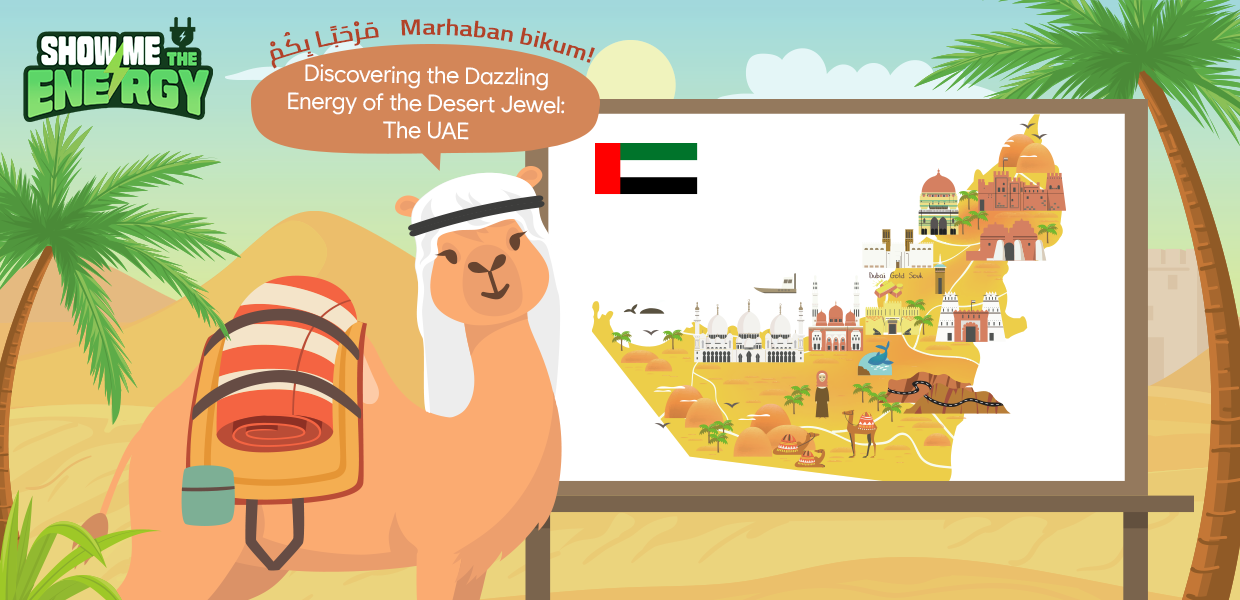
Marhaban bikum! (Welcome, everyone!)
I’m your guide for today, a friendly camel undaunted by the scorching desert heat.
Today, I’ll take you on a journey to the United Arab Emirates (UAE), my cherished homeland. I’m already excited at the thought of introducing you to this remarkable place!
Situated along the southeastern coast of the Arabian Peninsula, the UAE is a federation of seven emirates*: Abu Dhabi, Ajman, Dubai, Fujairah, Ras Al Khaimah, Sharjah, and Umm Al Quwain. It covers approximately 84,000 square kilometers and is home to around 11 million people.
* Emirate: In Islamic culture, an emirate refers to a nation or territory governed by an amīr (leader) and is called “imārah” in Arabic.
With vast desert landscapes swept by sandstorms, grand mosques at the heart of Islamic culture, society, and religion, as well as futuristic skyscrapers towering over luxury resort cities, this land harmoniously blends tradition and modernity. And of course, the UAE is well known as a “major oil producer.” But did you know that the country is exploring new future energy solutions beyond oil and natural gas? Let’s open up the UAE’s energy treasure box and take a look inside!
Gold of the Desert: Petroleum and Gas
The UAE is a global energy powerhouse, boasting the sixth-largest proven oil reserves in the world. As of 2023, the country holds about 100 billion barrels of crude oil and approximately 8.21 trillion cubic meters (m³) of natural gas.¹ These resources account for roughly 30% of the UAE’s gross domestic product (GDP), making them crucial to its economy.
After decades of exploration, the UAE discovered its first commercial oil field in 1958. Following its independence from the United Kingdom in 1971, it established the state-owned Abu Dhabi National Oil Company (ADNOC) and officially emerged as a leading oil producer.
Amidst the global climate crisis and shifting the geopolitical landscape, which are accelerating the transition in the energy paradigm, ADNOC is actively adapting to these changes. It is working towards expanding its production capacity of low-carbon fuels (low-carbon intensive hydrocarbons) to 5 million barrels per day by 20272 and aims to achieve net-zero carbon emissions by 2045. We’re eager to see the results of the UAE’s sustainable oil development efforts!
Why is “Dubai Crude” a Benchmark for Global Oil Prices?
“Dubai Crude” is a type of oil produced in the UAE and serves as a benchmark crude for determining the price of Middle East oil. It has a moderate sulfur content and is actively traded on the international market, making it a widely accepted pricing standard for other crude oils in the region.
Since about 70% of South Korea’s crude oil imports come from the Middle East, the price of Dubai Crude significantly impacts on Korean industry and economy. In response, SK On Trading International, a subsidiary of South Korea’s leading energy company, SK Innovation, has been operating a branch in Dubai to import and export not only crude oil but also biofuels and low-carbon fuels. This plays a key role in ensuring a stable supply of essential feedstocks for the energy and chemical industries.
☀️ Harnessing the Ruby-Blazing Sun: Solar Power
When you think of the UAE, oil might be the first thing that comes to mind. However, in the heart of the desert, another form of sustainable energy is emerging. By leveraging its abundant sunlight and vast expanses of land, the UAE operates the Mohammed bin Rashid Al Maktoum Solar Park, one of the largest solar power facilities in the world.
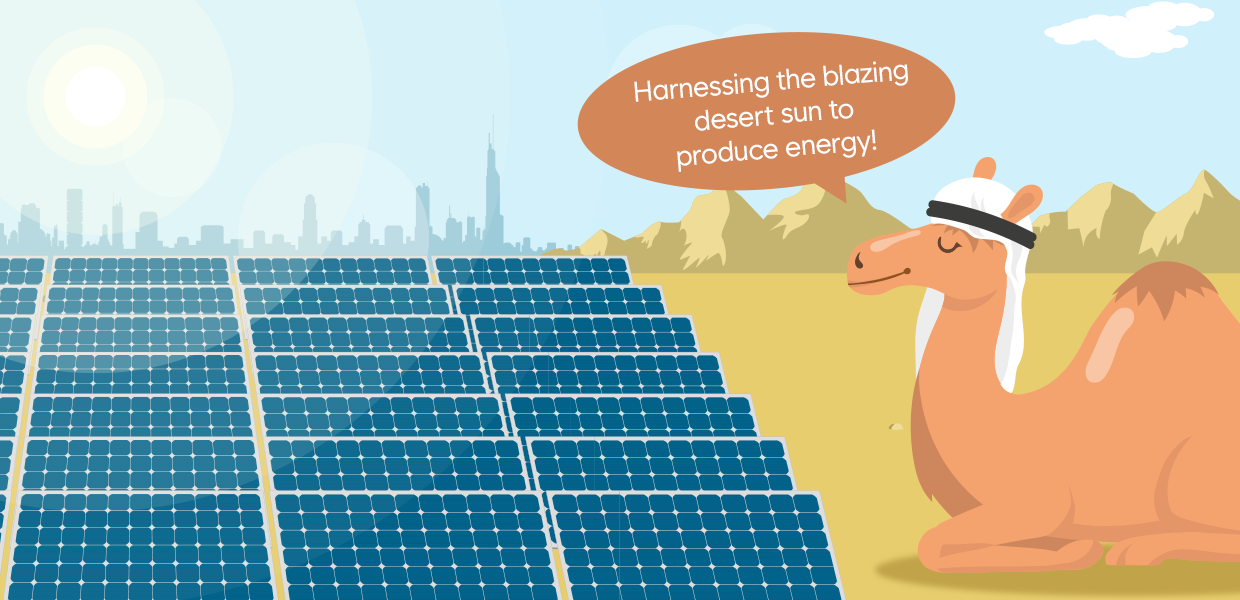
Initiated by the Dubai Electricity and Water Authority (DEWA) through an Independent Power Producer (IPP) model3, this solar park is a key part of the “Dubai Clean Energy Strategy 2050” and “The UAE’s Net Zero 2050 Strategy.” These initiatives aim to supply 100% of Dubai’s energy needs with clean energy by 2050.
The solar park employs a combination of Concentrated Solar Power (CSP)** and photovoltaic panels, currently generating over 3,000 megawatts (MW) of electricity.4 Notably, Phase 4 of this project holds a Guinness World Records as the largest single-site CSP plant in the world. It also features a massive thermal energy storage system with a capacity of 5,900 megawatt-hours (MWh), allowing for efficient storage of surplus energy.5 By 2030, the plant is expected to expand its production capacity to a total of 7,260 MW, making its future impact highly anticipated.
**Concentrated Solar Power (CSP): A method of generating electricity by using mirrors to focus sunlight, producing high-temperature heat that drives a power generator.
Sapphire of Clean Energy: Hydrogen
The new driving force behind the UAE’s energy innovation is none other than hydrogen. Depending on its production method, hydrogen is categorized as gray, green, blue, etc. The UAE is accelerating efforts to expand the production of blue and green hydrogen. Green hydrogen is produced by electrolyzing water using renewable energy, while blue hydrogen is made by treating natural gas with high-temperature steam. The carbon dioxide (CO2) generated in this process is captured and minimized using CCUS*** technology.
***CCUS (Carbon Capture, Utilization and Storage): An umbrella term for technologies that capture CO2 and either store it underground (CCS: Carbon Capture and Storage) or convert it into useful materials (CCU: Carbon Capture and Utilization).
According to the UAE’s National Hydrogen Strategy 2050, the UAE aims to establish at least two hydrogen production hubs, called “Oases”, by 2031 with a production goal of 1.4 million tons annually, scaling up to 7.5 million tons by 2040 and reaching 15 million tons by 2050.6
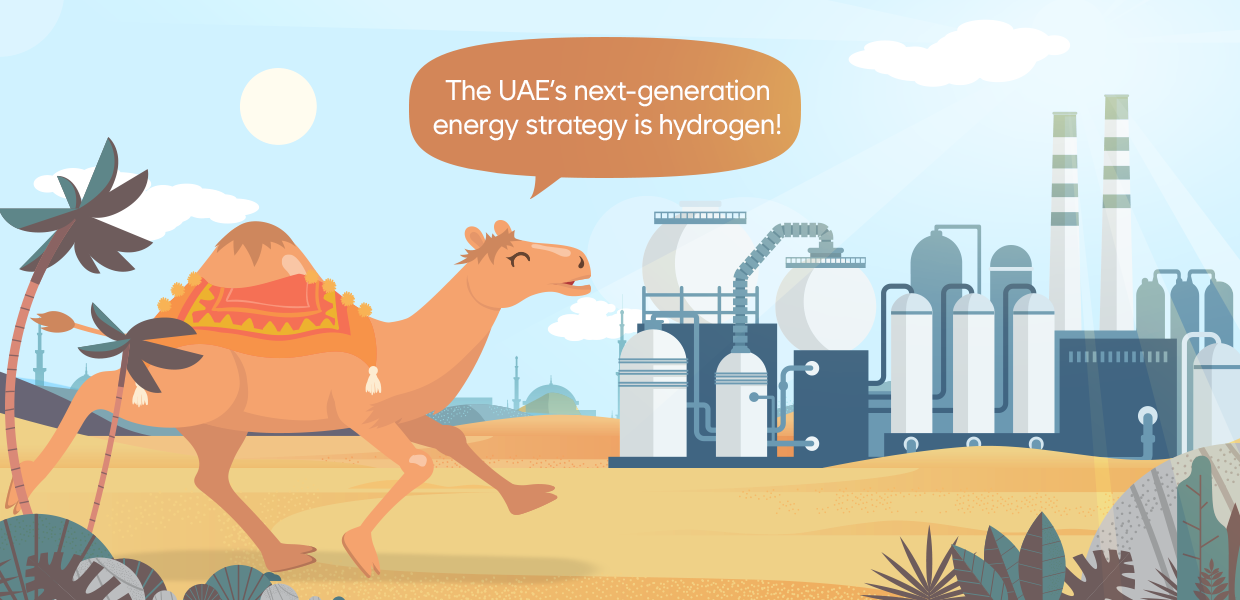
Leading hydrogen plant projects in the UAE include the Blue Ammonia Project at the Taziz petrochemical complex in Ruwais, located on Abu Dhabi’s western coast, and the Green Ammonia Facility being built in the Khalifa Industrial Zone Abu Dhabi (KIZAD) by a consortium of three companies, including ADNOC. The blue ammonia plant led by ADNOC is scheduled for completion this year and is expected to produce approximately 1 million tons of blue ammonia annually.7 Blue ammonia is made using blue hydrogen derived from nitrogen and natural gas. The carbon dioxide by-product generated during hydrogen production is captured and stored.
Meanwhile, the Green Ammonia Plant is being developed through a “Hydrogen Alliance” formed by Mubadala (Abu Dhabi’s sovereign wealth fund), ADNOC, and a state-owned holding company, ADQ, to enhance green and blue hydrogen capabilities. This facility uses solar energy to split water into hydrogen and oxygen—producing 40,000 tons of green hydrogen, which will be used to generate 200,000 tons of green ammonia.8 Isn’t it exciting to see hydrogen innovation blooming even in the heart of a desert?
⚛️ The UAE’s Pearl of Power: Nuclear Energy
The UAE is the first country in the Middle East to initiate commercial nuclear power generation, with the Barakah Nuclear Power Plant, whose name means “blessing” in Arabic, symbolizing this milestone. Doesn’t the name “Barakah” itself radiate positive energy? Operated by the Emirates Nuclear Energy Corporation (ENEC) in partnership with private companies, the Barakah Plant completed its first fuel loading in Unit 1 in March 2020, and by 2024, all four reactors had entered commercial operation.9 The plant produces 4,000 terawatt-hours (TWh) of electricity annually, supplying around 25% of the UAE’s total power demand.10
What’s even more remarkable is that the Barakah Nuclear Plant reduces approximately 22.4 million tons of carbon emissions every year—equivalent to removing about 4.8 million cars from the roads.11 The scale of its positive impact is truly impressive!
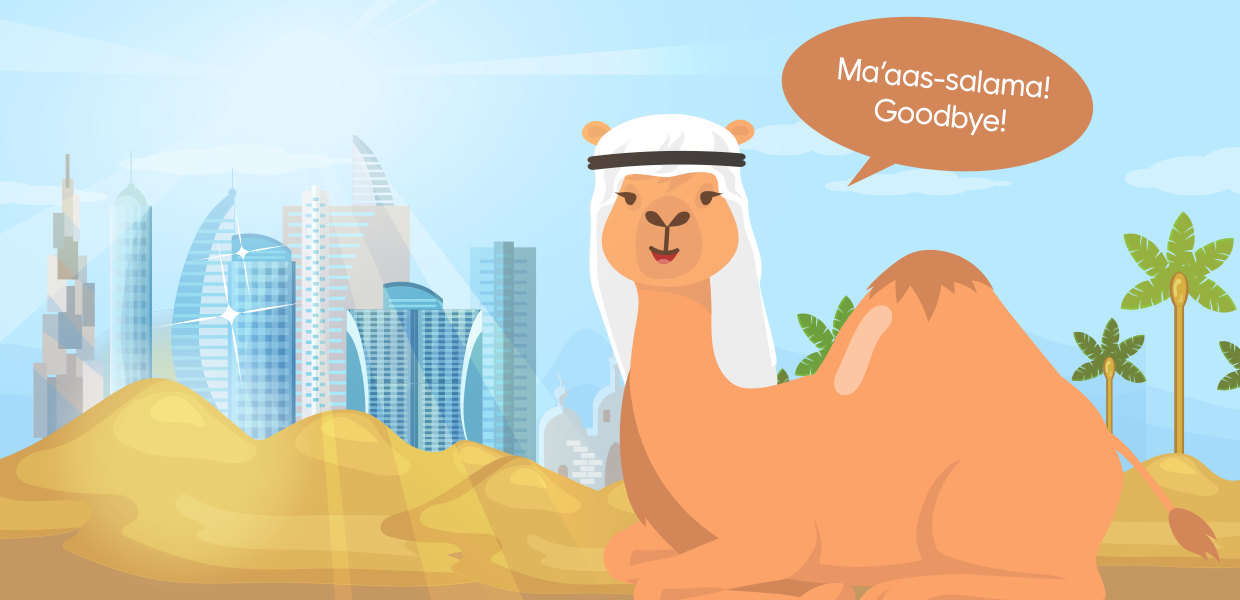
I hope you enjoyed our journey through the dazzling energy jewels of the UAE. Like the sun shining over the desert, the UAE is steadily illuminating its path to becoming a global energy leader with steadfast determination. Now, I must return to the desert in search of the next hidden gem. Ma’a as-salama! Goodbye!
[References]
1 U.S. Energy Information Administration (EIA). Country Analysis Brief: The United Arab Emirates (UAE), p. 4
2 ADNOC. We will responsibly. Responsible Growth
3 Government of Dubai, Dubai Electricity & Water Authority (DEWA), Sustainability & Innovation Centre. Mohammed bin Rashid AI Maktoum Solar Park
4 Energy and Economic Analysis Division of the Energy Policy Branch, Natural Resources Canada. (2024). Mohammed bin Rashid bin Mohammed bin Rashid Al Maktoum visits several strategic projects led by the Dubai Electricity and Water Authority, 28 April 2025
5 Government of Dubai, Dubai Electricity & Water Authority (DEWA). New Guinness World Record for the Mohammed bin Rashid Al Maktoum Solar Park, 19 May 2025
6 Sriram Suchitra, Mense Neeraj. Fueling the future: UAE hydrogen sector growth opportunities , Gulf Petrochemicals and Chemicals Association (GPCA), 27 September 2024
7 ADNOC. ADNOC to Build World-Scale Blue Ammonia Project, 24 May 2021
8 Abu Dhabi Ports. AED3.67 bn ‘Helios Industry’ Plant to Export Green Ammonia from Abu Dhabi, 25 May 2021
9 Emirates Nuclear Energy Company (ENEC), Sustainability Report 2023, p.8
10 Emirates Nuclear Energy Company (ENEC), Barakah Plant, Barakah Nuclear Energy Plant
11 Emirates Nuclear Energy Company (ENEC), The UAE Peaceful Nuclear Energy Program, p. 3