From Cell to Pack: Ensuring Safety at Every Level
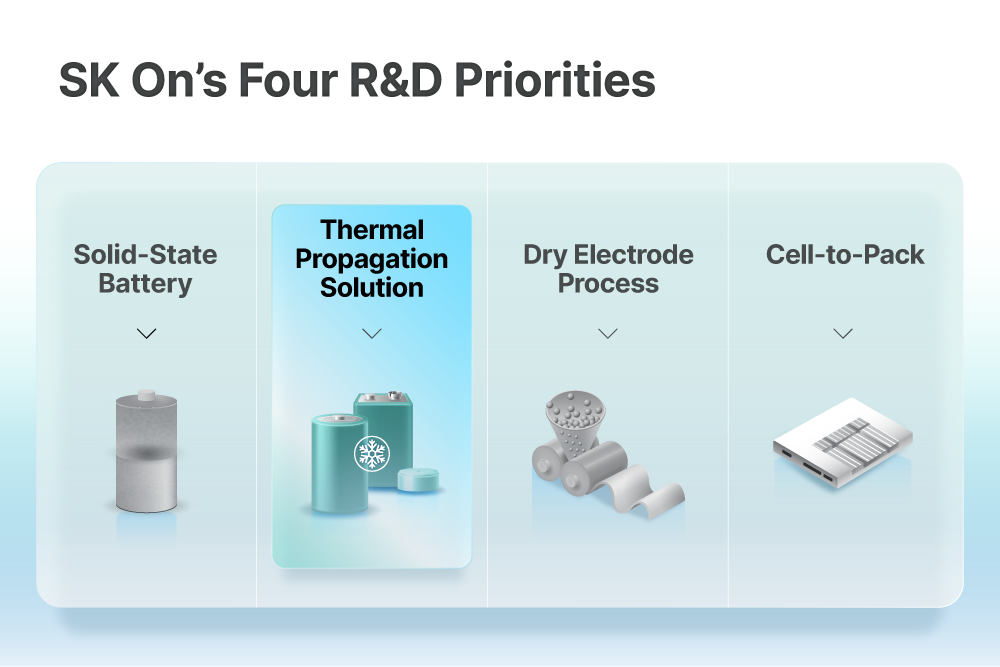
SK On is pursuing four key R&D priorities to lead the next-generation battery market: solid-state batteries, thermal propagation (TP) prevention solutions, the dry electrode process, and cell-to-pack (CTP) technology. Part 1 introduced the solid-state battery, which strengthens safety at the cell level. In Part 2, SK On is taking a closer look at TP prevention, a technology that enhances safety at the pack level.
What Makes Thermal Propagation Prevention So Critical
A battery pack is made up of hundreds of individual cells. As electricity flows, heat is generated inside each cell through electrical, chemical, and physical processes. When the heat produced in a single cell spreads to neighboring cells, this phenomenon is known as thermal propagation (TP). While some heat generation is expected during normal operation, the real concern arises when this heat is not controlled in time. Overheating that begins in one cell can trigger a chain reaction, rapidly escalating into pack-level thermal runaway events. For this reason, TP suppression is widely regarded as a core element of battery safety.
The 2025 amendments to the United Nations Global Technical Regulation (UN GTR No. 20, Phase 2) included enhanced TP-related requirements as part of its updated electric vehicle (EV) battery safety criteria. Energy research firm IDTechEx projects that by 2035, thermal management and fire protection systems will account for over 20% of the total cost of battery energy storage systems (BESS).
How to Suppress Thermal Propagation
The most fundamental approach to suppressing thermal propagation is insulation. Because heat spreads through contact points between cells, preventing that transfer requires the use of a substantial amount of insulating material between cells. However, adding more insulation increases weight and cost while reducing space efficiency. This is where cell-level cooling technologies come into play, helping minimize the need for excessive insulation.
Today, the most widely used TP suppression methods include bottom cooling, immersion cooling, and large-surface cooling. To address a wide range of customer thermal-management needs, SK On has developed a full portfolio encompassing all three approaches.
1) Bottom Cooling circulates coolant through a cooling plate installed beneath the battery pack, allowing the coolant to absorb heat from the cells and dissipate it outside the system. This is the most widely used approach because it can be implemented without altering vehicle design. Bottom cooling provides a simple structure and efficient use of space, but because cooling is concentrated at the bottom of the cell, it can be difficult to fully control heat generated at the cell’s center.
2) Immersion Cooling submerges the cells in an electrically insulating coolant, allowing the liquid to surround the entire surface of each cell and rapidly draw heat away from the core, where current flow is concentrated. SK On’s internal testing shows that immersion cooling delivers roughly twice the heat-suppression performance of bottom cooling. It effectively reduces the thermal load during rapid charging or high-speed driving, helping maintain stable cell temperatures. Immersion cooling can also be applied beyond electric vehicles, including to energy storage systems (ESS) and other industrial applications.
3) Large-Surface Cooling presses similarly-sized cooling plates tightly against the broad surface of the battery cells, enabling direct contact that draws heat evenly across the entire cell surface. The resulting uniform heat absorption helps maintain consistent temperatures throughout the pack. According to SK On’s testing, large-surface cooling delivers approximately three times the TP-suppression performance of bottom cooling.
Pouch-Type Cell-to-Pack System with Large-Surface Cooling: An Industry First
SK On is among the first in the industry to apply large-surface cooling technology to pouch-type cells. By removing the traditional module stage from the standard cell-module-pack structure, the company is developing a pouch-type cell-to-pack (CTP) system based on large-surface cooling. This structure offers several advantages: pouch cells are thinner, more flexible, and higher in energy density than prismatic or cylindrical form factors, and cooling plates inserted between cells serve as modules, improving both cooling efficiency and structural durability.
Strengthening Battery Safety at SK On
From solid-state batteries to thermal propagation suppression, SK On continues to advance technologies that enhance battery safety. To set new benchmarks for pack-level safety, the company is moving beyond today’s standards and strengthening its position in shaping the future of the battery industry. The next article in the series will explore another pillar of SK On’s R&D priorities — cost competitiveness — by focusing on innovations such as the dry electrode process and cell-to-pack technology.
■ Related articles

- [Battery Deep Dive] Part 1: Solid-State Batteries

- [Expert Lens] How Energy Security Presents a New Opportunity for the Korean Battery Industry

- [Techie Toons] AI’s Essential Routine – Cold Plunge

- [SKinno Tech] Immersion Cooling Technology