The Emergence of a Fourth Form Factor
As electric vehicles (EVs) and energy storage systems (ESS) must pack more energy into smaller spaces while meeting increasingly stringent safety standards, structural battery design is becoming increasingly important. Cell-level performance alone is no longer sufficient, so cell arrangement and pack configuration have become key factors in determining battery competitiveness.
Market trends reflect this shift. According to global consulting firm PwC, structural safety and thermal management in EVs and large-scale ESS continue to grow in importance. As safety standards become more rigorous, the number of internal pack components has increased. This has led to efforts to minimize module-level components, further driving demand for enhanced structural safety at the cell level.
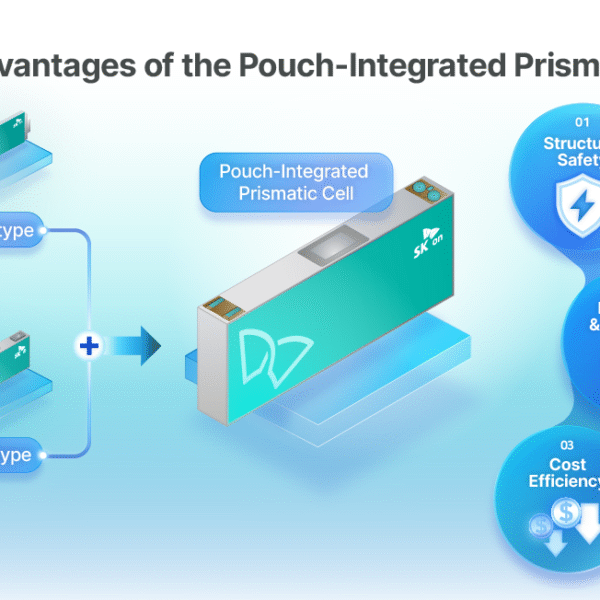
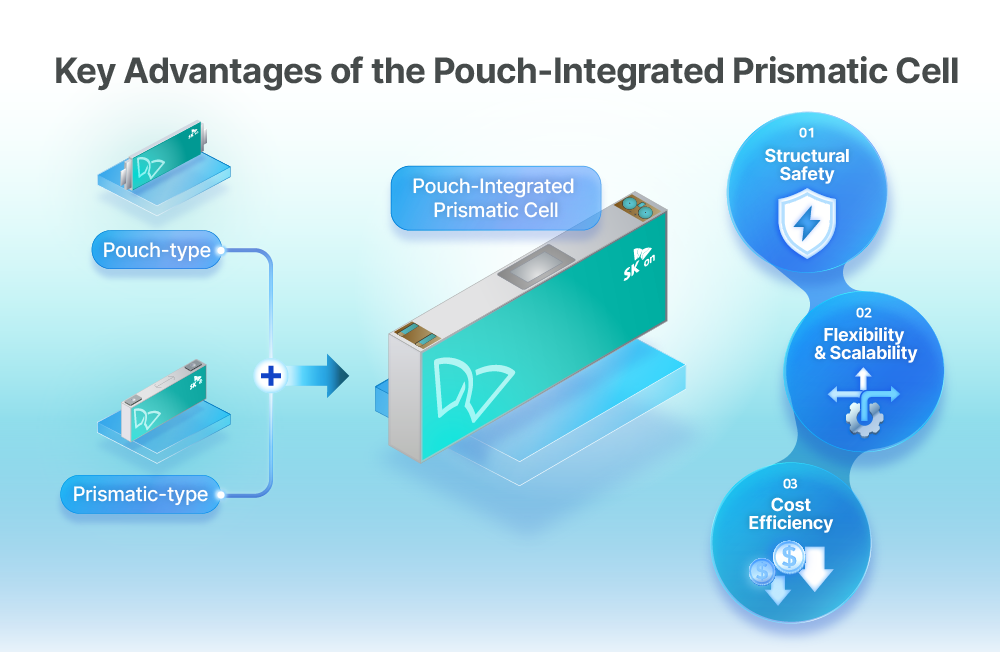
This trend is also evident in market adoption. Battery analytics firm Adamas Intelligence found that prismatic batteries accounted for 69% of total EV battery capacity in 2024, a significant increase from 42% in 2020. This growth is attributed to the rigid casing structure, advantageous for Cell-to-Pack (CTP) designs that eliminate modules. However, prismatic batteries alone cannot meet all requirements due to limited design flexibility stemming from standardized form factors. In response to this trend, SK On has introduced the Pouch-Integrated Prismatic Cell, a new approach that combines the advantages of pouch and prismatic cells to enhance safety and design flexibility beyond conventional prismatic batteries.
Enhanced Safety Through the Combination of Pouch and Prismatic Designs
Safety remains the most critical factor in battery technology, and the Pouch-Integrated Prismatic Cell enhances it by combining the strengths of both pouch and prismatic designs. Multiple mid-nickel pouch cells are stacked and enclosed within an aluminum case, creating a more robust structure. In this structure, the case supports the cells and helps maintain structural integrity even under external shocks or vibrations.
The Pouch-Integrated Prismatic design utilizes an aluminum case in which the pouch cells are directly bonded to the bottom cooling plate using a thermal adhesive (TA), enabling efficient heat dissipation during charging and discharging. In addition, large-area cooling can be achieved by placing cooling plates between the wide surfaces of the pouch cells within the integrated structure, further improving cooling performance. Moreover, thanks to aluminum’s high thermal conductivity and heat capacity, the case itself effectively spreads and absorbs heat, helping control thermal propagation (TP).
The design incorporates built-in directional venting, as well, which responds to abnormal situations by releasing high-temperature, high-pressure gas generated inside the cell in a controlled direction. By orienting the vent in a single direction, it can also minimize gas diffusion to adjacent cells.
To further enhance safety, the Pouch-Integrated Prismatic Cell also includes compression pads, which are placed between cells to suppress swelling*. Busbars used to connect and secure the cells are exposed outside the case, enabling direct connection to a printed circuit board (PCB). This makes it possible to detect cell performance degradation at an early stage.
*Swelling: expansion of a battery cell caused by internal pressure or gas generation during charge and discharge cycles.
Flexible and Scalable Design
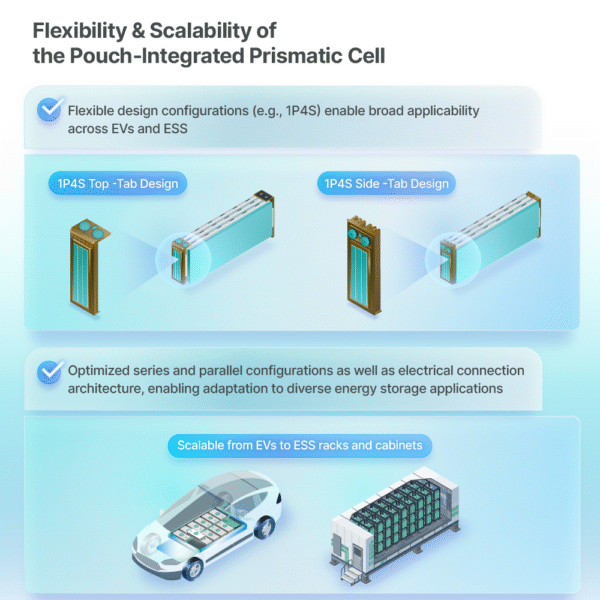
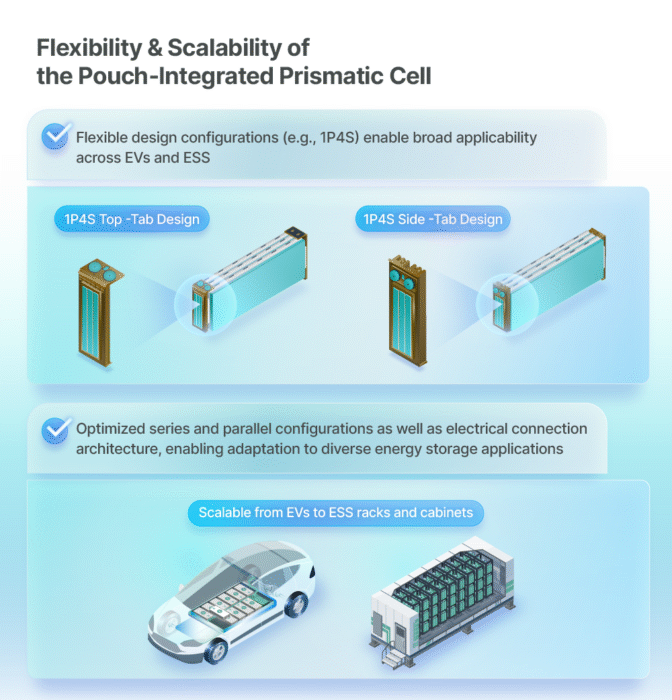
Another key advantage of the Pouch-Integrated Prismatic Cell is its design flexibility. Within the aluminum case, both the electrical configuration of the cells and the tab orientation for external pack connection can be flexibly designed. For example, depending on voltage and capacity requirements, cells can be configured in a variety of ways — such as 1P4S (1 in parallel, 4 in series) or 2P2S (2 in parallel, 2 in series).
Even within the same 1P4S configuration, both top-tab and side-tab designs can be implemented: the top-tab design places the positive and negative terminals on the top of the case, while the side-tab design positions them on the side. This high level of design flexibility enables the battery to meet diverse customer requirements and adapt to various applications, from EVs to ESS racks and cabinets. Furthermore, the structure — which stacks pouch cells within an aluminum case — allows for greater flexibility in cell size. This improves internal pack space utilization compared with conventional prismatic cells, by approximately 6.1%.
Enhanced Cost Competitiveness
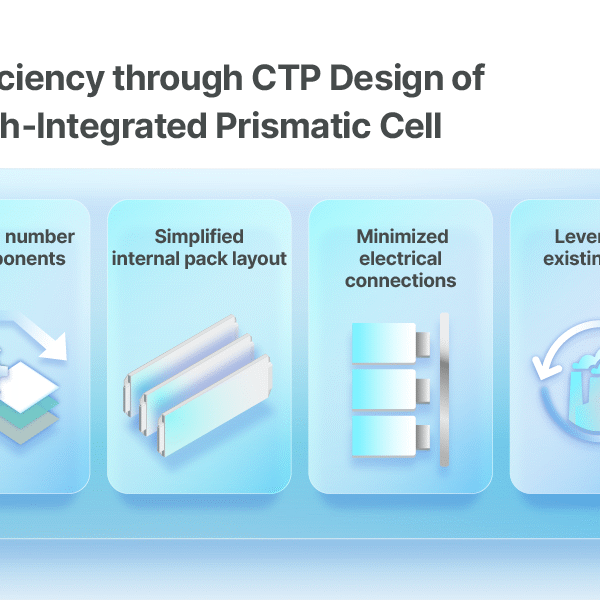
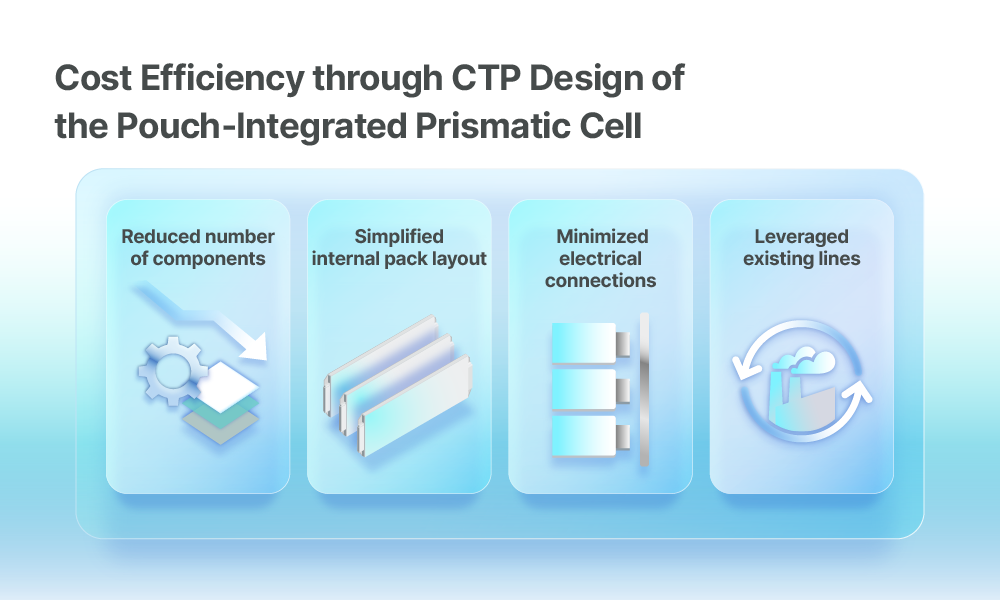
A key advantage of the Pouch-Integrated Prismatic Cell is its suitability for Cell-to-Pack (CTP) design. The structural rigidity of the aluminum case reduces the number of internal pack components and simplifies internal layout, improving cost competitiveness. In addition, aligning internal tabs in a single direction simplifies external busbar connections, minimizing the number of electrical connection components at the pack level.
From a manufacturing perspective, the design can be produced using existing pouch cell production lines, minimizing additional capital investment while achieving assembly efficiency comparable to that of prismatic cells.
As a result, reduced product costs and minimal investment in new equipment contribute to long-term improvements in total cost of ownership (TCO).
A New Battery Solution Driven by Structural Design Innovation
The Pouch-Integrated Prismatic Cell combines the design flexibility of pouch cells with the structural advantages of prismatic cells. Moving beyond a simple hybrid, it delivers optimal cell-level performance while simultaneously enhancing mechanical performance and safety at the pack level. Currently, SK On’s Pouch-Integrated Prismatic Cell is in the prototype phase for final performance validation, and development will continue toward commercialization.
As EV and ESS markets continue to advance, the importance of battery structures capable of meeting diverse and complex requirements will only grow. Building on its technology roadmap — including ultra-fast, seven-minute charging, On-Vent Cell technology, and now the Pouch-Integrated Prismatic Cell — SK On continues to expand its capabilities across both battery performance and structural design, shaping the future direction of next-generation battery technologies.
■ Related articles

- [Battery Deep Dive] Part 2: Thermal Propagation Prevention

- [Battery Deep Dive] Part 3: The Dry Electrode Process

- [Battery Deep Dive] Part 4: Cell-to-Pack Technology

- [Battery Deep Dive] Part 5: Seven-Minute Fast Charging

- [Battery Deep Dive] Part 6: On-vent Prismatic Cell